
Reviewed · GIZA PYRAMIDS & SPHINX TOURS
Day Tour To Dahshur Pyramids Memphis & Sakkara
The smaller pyramids tell the bigger story. This five-hour Cairo outing links Saqqara’s Step Pyramid with Dahshur’s Bent and Red Pyramids, then finishes at ancient Memphis. I like the private, air-conditioned vehicle and hotel pickup, and I like having an Egyptologist guide to explain why these monuments matter. The main caution is that guide quality can vary, and the added perfume, papyrus, cotton, and carpet stops may not suit anyone wanting only archaeology.
You get a lot for $40 per person: private transport, a guide, bottled water, hotel pickup and drop-off, and a local koshari lunch. The schedule also gives you a useful look beyond Giza, though several entry fees are extra and the advertised five-hour length leaves little room for lingering.
In This Review
- Key points at a glance
- Why Saqqara and Dahshur deserve your morning
- Saqqara and the Step Pyramid of Djoser
- The Pyramid of Teti and its extra ticket
- Pyramid Texts inside the Pyramid of Unas
- Everyday life at the Mastaba of Ti
- Dahshur’s Bent and Red Pyramids
- Ancient Memphis and the colossal Ramses statue
- The shopping stops and what they mean for your time
- Guide quality is the key variable
- Transport, lunch, and the value of $40
- Who should book this Cairo tour
- Should you book it?
- FAQ
- How long is the tour?
- Does the tour provide hotel pickup and drop-off?
- Is the tour private?
- What type of vehicle is used?
- Is a guide included?
- Is lunch included?
- Is bottled water provided?
- Are all entry fees included?
- Which ancient sites does the tour visit?
- Can the booking be canceled for a full refund?
Key points at a glance
- Three major ancient sites in one half-day: Saqqara, Dahshur, and Memphis cover several key stages of Egyptian pyramid building.
- Private touring: Only your group joins the activity, so you can ask questions and adjust the pace within the available time.
- Strong guide potential: Guides such as Mohammed, Jassy, and Habiba have received especially warm praise for clear explanations, good organization, and friendly service.
- A different pyramid experience: Dahshur and Saqqara are less focused on the giant Giza pyramids and offer a closer look at early design changes.
- Shopping stops are built in: Paradise Perfumes, Flower Cotton, Key of Life Papyrus, and a handmade carpet school may be included for about 20 minutes each.
- Check entry costs: Basic area access is included in some stops, but entry to places such as the Pyramid of Teti, Pyramid of Unas, and Mastaba of Ti is not included.
Why Saqqara and Dahshur deserve your morning
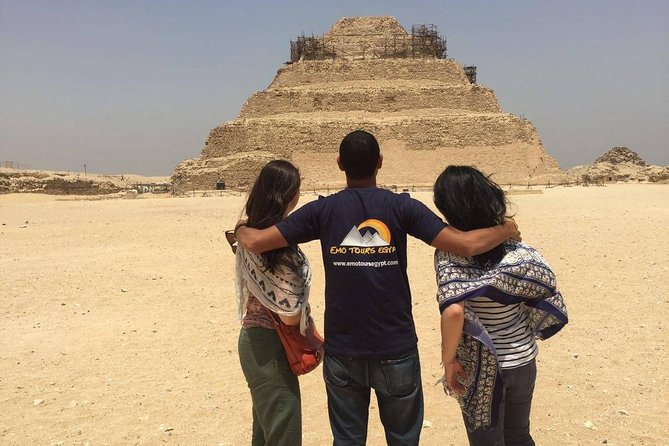
Giza gets the fame, but Saqqara and Dahshur explain how Egyptian pyramid building developed. Here, you see the experiments, changes, and practical problems that came before the familiar smooth-sided pyramids.
Saqqara lies about 27 kilometers southwest of Cairo. Dahshur is farther south, roughly 40 kilometers from Cairo, on the western bank of the Nile. The sites are spread out, so private transport matters. You are not wasting time changing buses or waiting for a large group to gather.
I especially like this route for a second day in Cairo. If you have already seen Giza, these sites give you a different view of royal burial architecture. One rating from the experience puts it at 4.8 out of 5 from 105 ratings, with 94 percent recommending it, which fits the tour’s main strengths: broad coverage, simple logistics, and generally strong guiding.
Still, do not expect a slow archaeological study. The planned stops are short, often around 30 minutes. The route is best for seeing a lot and getting a clear explanation of the main points, not for sitting quietly at each monument for hours.
More ways to see the pyramids and the Sphinx:
- Cairo: Pyramids & Great Sphinx Private Tour with Camel Ride
★ 4.9 · 6,335 reviews - Tour to Giza Pyramids and The Egyptian Museum
★ 5.0 · 6,016 reviews - VIP All inclusive Best of the best Giza Pyramids,Sakkara,Memphis
★ 5.0 · 3,164 reviews
Saqqara and the Step Pyramid of Djoser
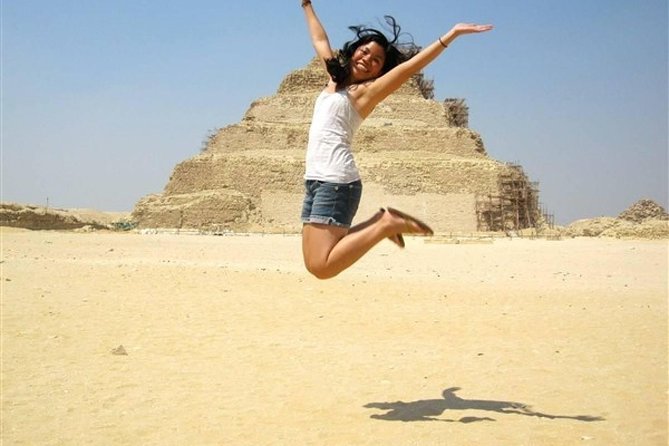
The first major archaeological stop is Saqqara, one of Egypt’s most important ancient burial areas. The central sight is the Step Pyramid, built for King Djoser, also spelled Zoser in some references.
This pyramid matters because it marks a major change in construction. Earlier royal tombs used the low, rectangular mastaba form. Djoser’s monument built upward in stacked levels, creating the stepped shape that helped lead to the later smooth-sided pyramids.
Your guide is most useful here. A good Egyptologist can turn weathered stone into a story about changing ideas, royal power, and the technical challenge of building in stone on such a large scale. Mohammed has been praised for explaining details in a way that is easy to follow, including reading hieroglyphic signs and answering questions about Egyptian culture beyond the monuments.
The planned visit is about 30 minutes, and basic area admission is listed as free or included. That is enough for an introduction and photographs. If the guide is strong, you should leave with a clear understanding of why Saqqara is more than just another pyramid field.
The Pyramid of Teti and its extra ticket
The Pyramid of Teti gives you another look at Saqqara during Egypt’s Old Kingdom. Teti was a pharaoh, and his pyramid served as his burial monument.
The stated visit lasts about 30 minutes, but the entry ticket is not included. This is one of the details to clarify before you leave your hotel. The tour price is attractive, yet the $40 does not cover every interior or special-area admission.
Going inside a pyramid can be physically demanding. The route may involve tight corridors and awkward movement, so you should be comfortable with that before paying for the extra ticket. One visitor specifically advised going inside despite the difficulty, saying the interiors added much to the day.
I would ask your guide which paid entries are most worthwhile if time is limited. Since the schedule is compact, paying for every optional area may not leave enough time to enjoy them properly.
Pyramid Texts inside the Pyramid of Unas
The Pyramid of Unas is smaller than many Old Kingdom pyramids, but its importance is not measured by size. Its underground chambers contain Pyramid Texts, religious spells carved into the walls to help the king in the afterlife.
These inscriptions are a major reason to consider the interior visit. The texts first appear in a pyramid connected with Unas, the last ruler of Egypt’s Fifth Dynasty. Later funerary traditions continued through the Pyramid Texts, Coffin Texts, and material linked with the Book of the Dead.
The visit is planned for roughly 30 minutes, and the entry ticket is not included. The site may appeal most to anyone interested in writing, religion, and the ideas behind Egyptian burial customs. If you only want large monuments for photographs, the small size may feel less impressive.
This is another place where the guide makes the difference. One strong guide, Mohammed, has been praised for explaining hieroglyphic writing and pointing out details that are easy to miss. A less capable guide could leave you looking at dark walls without understanding why they are important.
More Saqqara, Memphis and Dahshur days:
- From Cairo: Pyramids of Giza, Sphinx, Saqqara & Memphis Tour
★ 4.7 · 3,110 reviews - Cairo: Pyramids, Sakkara & Memphis Tour with Lunch
★ 4.6 · 2,493 reviews - Private Day Tour Giza Pyramids, Sphinx, Memphis, and Saqqara
★ 4.5 · 904 reviews - Private tour: GIza Pyramids, Memphis City & Sakkara Pyramid
★ 5.0 · 637 reviews
Everyday life at the Mastaba of Ti
The Mastaba of Ti offers a change from royal pyramids. This tomb belonged to Ti and was discovered by Auguste Mariette. Its walls show scenes of ordinary life, including work and daily activities.
That detail gives the tomb special value. Pyramids tell you about kings and the afterlife, but tomb scenes can show farming, crafts, food production, and social roles. They help connect the monuments to the people who built and maintained the society around them.
The mastaba contains two serdabs, enclosed spaces associated with the tomb’s statue arrangements. Admission is not included, and the scheduled stop is about 30 minutes.
I would consider this one of the most worthwhile optional stops for visitors who want more than a pyramid checklist. The artwork can offer a more human view of ancient Egypt, though your experience will depend on how much time remains after the other Saqqara visits.
Dahshur’s Bent and Red Pyramids
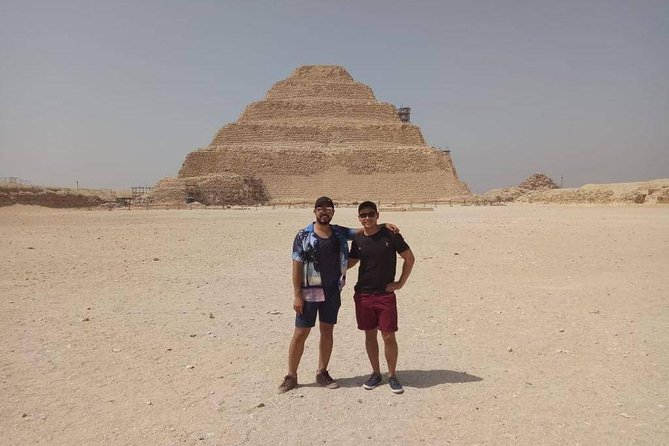
Dahshur is the architectural highlight for many people on this route. The area is a royal necropolis about 40 kilometers south of Cairo, and its two best-known pyramids are the Bent Pyramid and the Red Pyramid.
The Bent Pyramid is famous for its unusual change in angle. The lower section rises steeply, then the upper section becomes flatter. This design change gives you a visible clue about the challenges faced by early pyramid builders.
The Red Pyramid, also called the North Pyramid, is one of the oldest large smooth-sided pyramids in Egypt and one of the best preserved. It offers a useful comparison with the Bent Pyramid and with the later pyramids at Giza.
The scheduled Dahshur visit lasts about an hour, with basic area admission listed as free. That hour is valuable because the pyramids are not just another pair of photo stops. You can compare their shapes and see how royal architecture developed from one project to the next.
Some visitors find the interiors hard because of the cramped passageways and physical effort. If you want to enter, wear practical shoes and ask what is open and included before you commit to the additional cost. The tour description does not include every interior admission, so do not assume that the $40 covers them all.
Ancient Memphis and the colossal Ramses statue
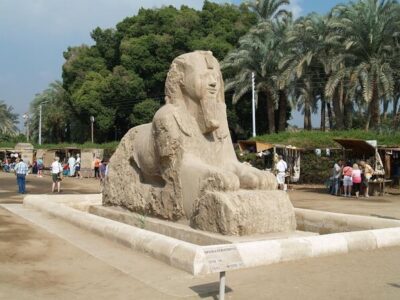
The final historical stop is Memphis, Egypt’s ancient capital, dating back to about 3100 BC. The site is known for the colossal statue of Ramses II and the large Alabaster Sphinx.
Memphis feels different from Saqqara and Dahshur. Instead of focusing on a single pyramid, you get a compact look at the city that once served as a major center of Egyptian power. The surviving monuments are reminders that the ancient capital was much larger than the remains you see today.
The itinerary allows about an hour for Memphis and the return to your hotel. That makes the timing slightly unclear in practice, since pickup, driving, site visits, lunch, and shopping are all packed into a five-hour experience. Ask your guide at the start how the day will be divided.
Memphis is a good final stop because it broadens the story. You move from royal tomb design to the city and political world that supported these monuments.
The shopping stops and what they mean for your time
This experience includes government-related shopping stops where you can see Egyptian products and crafts. The listed locations include Paradise Perfumes, Flower Cotton, Key of Life Papyrus, and a handmade carpet school.
Each stop may take about 20 minutes. At Paradise Perfumes, you can examine natural oils. Flower Cotton focuses on Egyptian cotton. Key of Life Papyrus includes papyrus-making demonstrations and traditional artwork. At the carpet school, you can watch artisans weaving rugs.
These visits may be useful if you want souvenirs or a quick look at local craft production. The carpet school can also show how much handwork goes into a finished rug. On the other hand, the stops reduce the time available at the ancient sites.
This is one of the clearest tradeoffs in the tour. Some people appreciate a chance to browse and buy. Others find that perfume shops, papyrus stores, and carpet demonstrations feel like sales stops, especially on a short archaeological outing. Tell your guide early if your priority is monuments rather than shopping, and ask how much time can be kept for Saqqara and Dahshur.
Guide quality is the key variable
The best part of this experience can be the guide. Mohammed has been praised for making large amounts of information easy to understand, explaining Egyptian culture, and even reading hieroglyphic inscriptions. Jassy is described as cheerful, energetic, helpful with photographs, and enthusiastic about Egyptian history. Habiba has also received praise for good organization, timing, and historical explanations.
Those positive experiences show what a private tour can offer. You can ask questions without worrying about holding up a busload of people. You may also be able to spend more time at a site that interests you, although the full route and short duration limit how much flexibility is realistic.
The weaker experiences point to an important risk. One guide struggled with English, used a mobile phone to read explanations, and did not provide the expected historical context. Another booking involved a guide arriving almost an hour late, getting lost on the way to the hotel, rushing through parts of the route, and adding pressure around the rating afterward.
I would confirm the guide’s language ability and Egyptology credentials before departure. Also confirm the pickup time and hotel address the day before. Most positive accounts describe punctual, organized service, but the negative experiences show that communication is worth checking rather than assuming.
Transport, lunch, and the value of $40
The tour uses a private, air-conditioned, late-model vehicle. Hotel pickup and drop-off are included for hotels in Cairo or Giza, and bottled water is provided.
That arrangement is worth real money in Cairo. You avoid negotiating separate taxis between several sites, and you can return directly to your hotel. A private vehicle is especially useful because Saqqara, Dahshur, and Memphis are not one compact attraction.
Lunch at a local restaurant is included, with koshari listed as the meal. Koshari is a filling Egyptian dish, usually built around rice, pasta, lentils, chickpeas, tomato sauce, and fried onions. The meal has received positive comments, but personal items and tips are not included.
At $40 per person, the tour offers good value if you want transport, guiding, lunch, and multiple archaeological sites in one booking. The value becomes less clear if you pay several additional entry fees and spend much of the day in shops. Private touring also normally costs more than joining a group, but here the difference buys comfort and control.
Who should book this Cairo tour
I would recommend it to a first-time Cairo visitor who has a spare half-day and wants to see more than Giza. It also suits anyone interested in how pyramids changed over time, especially the contrast between Djoser’s Step Pyramid, Dahshur’s unusual forms, and the smoother pyramids that followed.
It works well for couples, families, or small groups who prefer a private vehicle and direct hotel service. The guide can answer questions at your level, and you do not have to fit into a large group’s pace.
I would be more cautious if you dislike shopping stops, need long unhurried visits, or want guaranteed specialist commentary in a particular language. You should also budget for optional admission fees and tipping.
Should you book it?
Book this tour if you want an efficient, private introduction to Saqqara, Dahshur, and Memphis at a low headline price. The strongest experiences come from the Egyptologist guides, with Mohammed, Jassy, and Habiba singled out for clear explanations, warmth, and good organization.
Before confirming, ask exactly which entry tickets are included, whether the shopping stops are required, who will guide your group, and how the five-hour schedule will work. If those answers are clear, this is a useful alternative to another standard Giza visit. If you want a pure archaeology day with no commercial stops, choose a tour that removes the shops or arrange a private guide with a more flexible schedule.
FAQ
How long is the tour?
The experience lasts approximately five hours.
Does the tour provide hotel pickup and drop-off?
Yes. Pickup and drop-off are offered from hotels in Cairo or Giza.
Is the tour private?
Yes. Only your group participates in the private activity.
What type of vehicle is used?
Transfers are provided in a private, air-conditioned, late-model vehicle.
Is a guide included?
Yes. A tour guide is included, and the experience is intended to include a qualified Egyptologist guide.
Is lunch included?
Yes. Lunch at a local restaurant is included, with koshari listed as the meal.
Is bottled water provided?
Yes. Bottled water is included.
Are all entry fees included?
No. Basic area admission is included for some locations, but entry to the Pyramid of Teti, Pyramid of Unas, and Mastaba of Ti is listed as not included.
Which ancient sites does the tour visit?
The route includes Saqqara’s Step Pyramid, the Pyramid of Teti, the Pyramid of Unas, the Mastaba of Ti, Dahshur’s Bent and Red Pyramids, and Memphis.
Can the booking be canceled for a full refund?
Yes, if you cancel at least 24 hours before the experience start time. Cancellations or changes made less than 24 hours before the start time are not accepted for a refund.
Just added around Cairo
- GEM Grand Egyptian Museum Private Tour from Cairo Giza hotels★ 5.0 · 23 reviews
- Day Tour To Giza Pyramids, Great Sphinx, Saqqara Pyramids & Memphis Capital★ 5.0 · 23 reviews
- Cairo vip two or one day pyramids ,Museum,memfis ,saqra and7 places★ 5.0 · 23 reviews
- Giza Pyramids, Sphinx, Saqqara, and Dahshur Tour with Camel Ride★ 5.0 · 23 reviews
- 8 Day Cairo Pyramids and Nile cruise and Alexandria All inclusive Private Tour★ 5.0 · 23 reviews
- Full-Day Tour to Giza Pyramids Saqqara Memphis Sphinx Private★ 5.0 · 23 reviews
- Half Day Guided Trip To Egyptian Museum★ 4.5 · 23 reviews
- Full-Day Tour to Giza Pyramids, memphis and Sakkara Step Pyramid★ 5.0 · 23 reviews
Giza Pyramids & Sphinx Tours, compared.
Pyramids & Great Sphinx Private Tour with Camel Ride
Read our review →
Tour to Giza Pyramids and The Egyptian Museum
Read our review →
VIP All inclusive Best of the best Giza Pyramids,Sakkara,Memphis
Read our review →
Pyramids of Giza, Sphinx, Saqqara & Memphis Tour
Read our review →
Cairo 8 Hour Private Tour of Pyramids, Egyptian Museum and Bazaar
Read our review →
Half-Day Tour to Pyramids of Giza and the Sphinx
Read our review →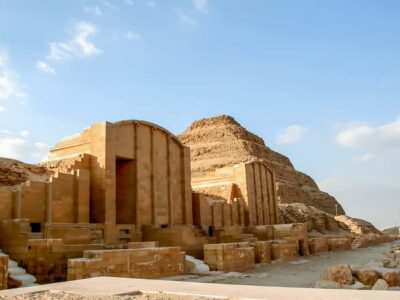
Browse the lists this tour appears in