
Reviewed · SAQQARA, MEMPHIS & DAHSHUR TOURS
Private Tour: Memphis and Sakkara
Ancient Egypt begins before the Great Pyramid. This short private tour takes you from Cairo or Giza to Memphis and Saqqara, two key sites for understanding how Egyptian pyramid building began. You get a private air-conditioned vehicle, hotel pickup and drop-off, and an Egyptologist guide who can shape the pace around your interests.
I like the chance to see Saqqara’s remarkable Step Pyramid, the oldest pyramid in Egypt, without the time demands of a full-day outing. I also like the private format, since you can spend longer at the tombs or statues that catch your eye. The main drawback is that Memphis is modest compared with Saqqara. A few major statues and museum pieces make the stop worthwhile, but some visitors may find the site sparse.
In This Review
- Key points to know before booking
- Why Memphis and Saqqara belong together
- Memphis and the giant Ramses statue
- Saqqara’s Step Pyramid and early royal design
- The value of an Egyptologist guide
- A private vehicle and a flexible morning
- The optional Papyrus Institute stop
- Price, timing, and what you receive
- Who will get the most from this tour
- Practical tips for a better visit
- Should you book Memphis and Saqqara?
- FAQ
- How long does the private Memphis and Saqqara tour last?
- What time does the tour start?
- Is hotel pickup included?
- Is this a private activity?
- What language is included in the price?
- Is lunch included?
- Can I cancel for a full refund?
Key points to know before booking
- The Step Pyramid is the main event: Saqqara gives you an early look at pyramid design, long before the smooth-sided pyramids at Giza.
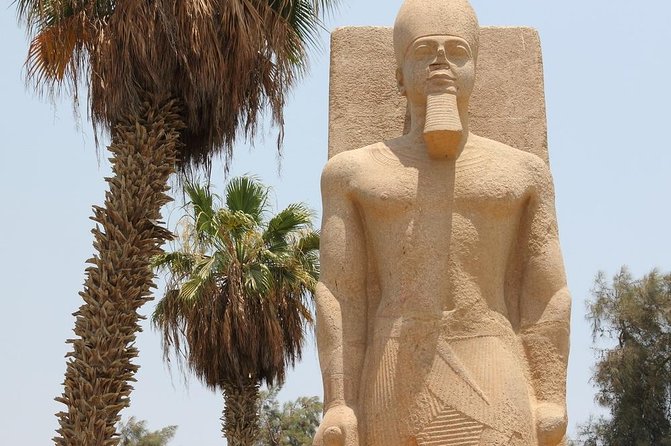
- Memphis is best for its Ramses II statue: The open-air museum includes a huge fallen statue of Ramses, which you can view from several angles.
- A private guide changes the pace: You can ask questions, pause for photographs, or move on when a site has given you enough.
- The tour lasts about three to four hours: The listed visits allow about an hour at Memphis and about an hour at Saqqara, with driving time between them.
- Hotel pickup is included: Pickup and drop-off are offered from Cairo and Giza, with extra transfer charges for some outlying areas.
- The Papyrus Institute is optional: You can see how papyrus scrolls are made, but you can also decline this stop if you prefer more archaeological time.
Why Memphis and Saqqara belong together
Memphis was founded around 3100 BC and is linked with Menes, the ruler traditionally credited with uniting Upper and Lower Egypt. Its position helped control routes between the Nile Valley and the Delta, making it an important early royal center.
Saqqara was the large burial ground connected to Memphis. The two sites therefore tell one story: Memphis was the capital and seat of power, while Saqqara served as a place for royal tombs, pyramids, religious buildings, and elite burials.
That connection matters when you visit. Saqqara is not simply another pyramid stop. It is part of the burial zone of one of Egypt’s earliest capitals, and the monuments make more sense when your guide explains how royal power, religion, and burial customs developed together.
I would not choose this outing only because it includes two names on a map. I would choose it because it shows an earlier stage of Egyptian civilization. Giza is famous for its perfect geometry. Saqqara feels more like a lesson in experimentation.
More Saqqara, Memphis and Dahshur days:
- VIP All inclusive Best of the best Giza Pyramids,Sakkara,Memphis
★ 5.0 · 3,164 reviews - From Cairo: Pyramids of Giza, Sphinx, Saqqara & Memphis Tour
★ 4.7 · 3,110 reviews - Cairo: Pyramids, Sakkara & Memphis Tour with Lunch
★ 4.6 · 2,493 reviews
Memphis and the giant Ramses statue
The Memphis portion usually takes about an hour. This is a compact visit, and that is probably the right length. The site does not offer the same scale of monuments as Giza or Saqqara, but it contains important pieces that help explain Memphis’s royal role.
The highlight is the enormous reclining statue of Ramses II in the open-air museum. Its size is striking even though the statue is displayed lying down. You can walk around it and see details from different sides, something that makes the visit more rewarding than a quick photograph from a distance.
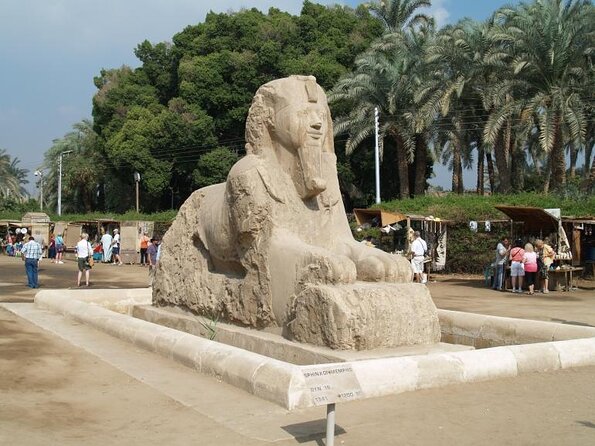
There is also an alabaster sphinx, along with other remains connected to ancient Memphis. The setting can feel less dramatic than Saqqara. Souvenir stands and areas under scaffolding may also reduce the sense of a polished archaeological park.
That is the honest tradeoff. I would not call Memphis a must-see on its own for every short Cairo visit. If you have limited time and must choose between Memphis and another major ancient site, Saqqara deserves priority. But with private transportation and a guide, Memphis adds useful context and gives you the Ramses statue, which many people consider the best reason to stop.
Your guide can also explain what may still lie beneath or beyond the visible remains. One account of the visit noted that historians believe additional statues could remain in the area behind the museum. You will not see all of ancient Memphis in an hour, but you will get a clear sense of how much has been lost, buried, or still awaits study.
Saqqara’s Step Pyramid and early royal design
Saqqara is the stronger half of the tour. Its Step Pyramid, built for Djoser, is widely recognized as the oldest pyramid in Egypt. The monument is made of stacked levels, giving it the stepped shape that marks an early stage in pyramid construction.
The site helps you picture the shift from earlier flat-topped royal tombs to the giant pyramids that followed. Instead of seeing a finished formula, you are looking at an important stage in its development.
Plan to walk around the pyramid’s perimeter and listen closely as your Egyptologist explains the design and its place in the wider necropolis. The guide’s explanation is especially useful here because the monument’s importance is not limited to its appearance. Without context, you may simply see a weathered stone structure. With a good explanation, you can follow the architectural idea that made it such a turning point.
The Saqqara area also includes royal and elite tombs, and the experience may include entry into a tomb such as the Pyramid of Teti, depending on the day’s arrangements and the exact program offered. Ancient wall paintings and reliefs can be among the most memorable parts of the stop. Several visitors especially valued having a guide point out favorite scenes instead of leaving them to search without help.
I would give Saqqara more time if you have a strong interest in ancient art, tomb decoration, or pyramid construction. The private format helps because you are not tied to a fixed group schedule. You can ask to linger at a tomb, spend extra time photographing the Step Pyramid, or move along if the heat and walking begin to wear you down.
The value of an Egyptologist guide
The guide can make or break this experience. The sites are important, but the meaning is not always obvious from the stones alone. A strong Egyptologist turns a series of statues, walls, and tombs into a connected story about kingship and burial.
Several guides received especially warm praise for clear English, strong storytelling, and personal attention. Names highlighted in the feedback include Mohammed, Mohamad, Osama, Tito, Ahmad, Mahmoud, Fouad Salah, and Chaly. You cannot assume you will receive a particular guide, but you can ask if a preferred guide is available when booking.
Mohammed was praised for bringing the stories of Alexander the Great, Antony and Cleopatra, and Ramses into the tour. Mahmoud was valued not only for his explanations but also for helping with group photographs. Tito was singled out for especially useful information at Saqqara.
The best guide style for this outing is not simply a person who recites dates. You want someone who notices what interests you, explains without rushing, and leaves room for questions and photographs. Most feedback points to guides who stayed with the group and explained the sites rather than dropping people at the entrance.
Still, the experience can vary. One poor account described a guide moving too quickly, making it hard for part of the group to keep up or take photographs. If you need a slower pace, say so at the beginning. A private tour gives you a good reason to set that expectation early.
More things to do in Cairo:
- Cairo: Pyramids & Great Sphinx Private Tour with Camel Ride
★ 4.9 · 6,335 reviews - Tour to Giza Pyramids and The Egyptian Museum
★ 5.0 · 6,016 reviews - Cairo 8 Hour Private Tour of Pyramids, Egyptian Museum and Bazaar
★ 5.0 · 2,931 reviews - Private ViP all-inclusive Giza Pyramids,Sphinx,Inside Pyramid
★ 5.0 · 2,448 reviews
A private vehicle and a flexible morning
The tour starts at about 9:00 am and lasts roughly three to four hours. A private air-conditioned minivan collects you from your hotel in Cairo or Giza and returns you afterward.
That arrangement is valuable in Cairo. You avoid arranging a separate taxi, negotiating each transfer, or trying to coordinate two major archaeological sites on your own. The private vehicle also gives your group a place to cool down between stops.
The itinerary allows about one hour at Memphis and one hour at Saqqara, not counting driving time. In practice, the private design means you may be able to adjust the balance. If Memphis takes only 45 minutes, you can ask for more time at Saqqara. If you are traveling with children or need a pause, the vehicle gives you more control than a large group coach.
Families may find this format particularly helpful. The private van allowed one family to take breaks for a two-month-old baby, while the guide kept older children engaged with nicknames and friendly attention. Another family with children aged 7, 5, and 3 appreciated a guide who made the outing easier for the children.
The vehicle is also useful for mixed-interest groups. One person can focus on photography, another on tomb art, and another on the historical explanation without the pressure of matching a large group’s schedule.
The optional Papyrus Institute stop
After the archaeological visits, you may have the chance to visit a Papyrus Institute. The purpose is to show how papyrus artwork and scrolls are made, linking a famous ancient material with a modern presentation.
This can be a pleasant extra if you are curious about the craft or want to look for a souvenir. It is not required, and the tour information makes clear that you can tell your guide you do not want this stop.
I would decide based on your priorities. If this is your first and perhaps only visit to Saqqara, I would protect archaeological time first. If you have already seen the main monuments and want a short craft demonstration, the institute may add variety.
Be clear with your guide before the day gets underway. The private format means your preference should be easier to accommodate, but it is better to state it plainly rather than assume the stop will be skipped.
Price, timing, and what you receive
The listed cost is $100.92 per person. That price buys more than admission to two sites. It includes private transportation, hotel pickup and drop-off, an English-speaking Egyptologist, and admission tickets for the stated visits.
The value depends heavily on group size. For one or two people, the price is higher than joining a basic group excursion, but you gain a private vehicle and control over the pace. For a family or small group, the per-person cost may feel more reasonable because you are sharing the vehicle and guide while avoiding the compromises of a large tour.
Lunch is included only if you select an option that includes it. Do not assume food is part of the base price. The Papyrus Institute visit is also an optional part of the day rather than the main archaeological program.
English is included in the stated price. A supplement of 1000 Egyptian pounds applies for guides in other languages. Additional round-trip transfer charges of 1000 Egyptian pounds per car apply to the 6th of October, North Coast Capital, and Settlement areas listed in the tour details.
The tour is often booked about 44 days ahead. That is useful planning information if your dates are fixed, especially if you hope to request a particular guide or need a certain language. Confirmation is provided at booking, and free cancellation is available until 24 hours before the start time. Changes or cancellations inside that period are not refunded.
Who will get the most from this tour
I would recommend this outing to anyone who wants more than the standard Giza visit. Saqqara explains how pyramid building began, while Memphis adds the story of the capital that supported the royal burial grounds.
It suits:
- History fans who want early dynastic Egypt and the reign of Ramses II placed in context.
- Families who need a private vehicle, flexible pauses, and a guide who can keep children interested.
- Photographers who want time around the Step Pyramid and the Ramses statue.
- Short-stay visitors who want two major sites in a single morning.
- Small groups who value private transport and a flexible schedule.
I would hesitate if Memphis is your main reason for booking. The site is smaller and less visually complete than Saqqara, and you may find the museum surroundings plain. I would also hesitate if you want a long, slow archaeological day. At three to four hours, this is an efficient introduction, not an exhaustive exploration of the Memphis necropolis.
Practical tips for a better visit
Tell the guide what matters to you before leaving the hotel. Ask for more time at Saqqara if the Step Pyramid and tombs interest you most, or ask for a slower walking pace if your group includes young children or anyone with limited stamina.
Wear comfortable shoes. The visit involves walking around outdoor archaeological areas, and the private car is most useful when you can return to it ready for the next stop.
Keep your camera ready at Memphis. The Ramses statue is large enough to reward wide views, while walking around it gives you details that a single front-facing photograph will miss.
If you care about ancient wall art, ask your guide to point out specific reliefs and frescoes. The strongest guides personalize the explanation instead of giving only a general speech.
Finally, treat the Papyrus Institute as optional. It may be worthwhile for some people, but it should not replace the monuments that brought you to Saqqara.
Should you book Memphis and Saqqara?
Yes, if you want a short private tour with a strong focus on early Egyptian monuments. Saqqara is the clear star, and the Step Pyramid alone makes the outing worthwhile for many people. Memphis is a useful companion, especially for the giant Ramses II statue and the story of Egypt’s early capital.
The tour offers good value when you want hotel pickup, a private air-conditioned minivan, an English-speaking Egyptologist, and control over your schedule. Book it if you prefer personal attention and a manageable morning. Skip or modify it if Memphis sounds less appealing, and ask about giving Saqqara more time or adding Dahshur if that option is available for your day.
FAQ
How long does the private Memphis and Saqqara tour last?
The experience lasts approximately three to four hours. The listed visits allow about one hour at Memphis and one hour at Saqqara, with travel time between the sites.
What time does the tour start?
The stated start time is 9:00 am.
Is hotel pickup included?
Yes. Hotel pickup and drop-off from Cairo and Giza are included with private air-conditioned transportation.
Is this a private activity?
Yes. Only your own group participates in the tour.
What language is included in the price?
An English-speaking Egyptologist guide is included. A supplement of 1000 Egyptian pounds applies to languages other than English.
Is lunch included?
Lunch is included only when you choose the option that includes lunch.
Can I cancel for a full refund?
Yes. You can cancel at least 24 hours before the experience start time for a full refund. Cancellations or changes made less than 24 hours before the start time are not refunded.
Just added around Cairo
- Day Tour To Giza Pyramids, Great Sphinx, Saqqara Pyramids & Memphis Capital★ 5.0 · 23 reviews
- GEM Grand Egyptian Museum Private Tour from Cairo Giza hotels★ 5.0 · 23 reviews
- Cairo vip two or one day pyramids ,Museum,memfis ,saqra and7 places★ 5.0 · 23 reviews
- Giza Pyramids, Sphinx, Saqqara, and Dahshur Tour with Camel Ride★ 5.0 · 23 reviews
- 8 Day Cairo Pyramids and Nile cruise and Alexandria All inclusive Private Tour★ 5.0 · 23 reviews
- Full-Day Tour to Giza Pyramids Saqqara Memphis Sphinx Private★ 5.0 · 23 reviews
- Half Day Guided Trip To Egyptian Museum★ 4.5 · 23 reviews
- Full-Day Tour to Giza Pyramids, memphis and Sakkara Step Pyramid★ 5.0 · 23 reviews
Saqqara, Memphis & Dahshur Tours, compared.
VIP All inclusive Best of the best Giza Pyramids,Sakkara,Memphis
Read our review →
Pyramids of Giza, Sphinx, Saqqara & Memphis Tour
Read our review →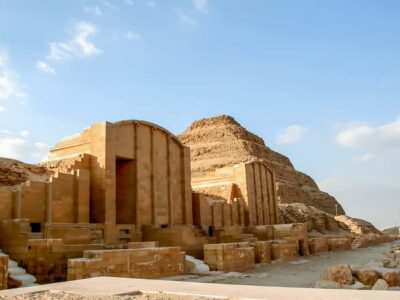
Private Day Tour Giza Pyramids, Sphinx, Memphis, and Saqqara
Read our review →
Private tour: GIza Pyramids, Memphis City & Sakkara Pyramid
Read our review →
Sakkara, Memphis & Dahshur (Pyramid & Felucca Options)
Read our review →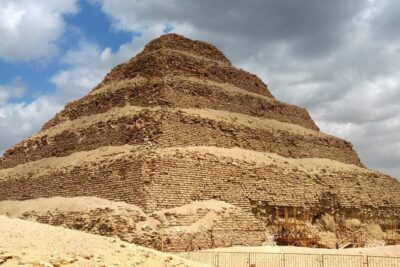
Private Full-Day Tour to Giza Pyramids,Sphinx,Memphis, and Saqqara
Read our review →
All-inclusive Private Trip Giza Pyramids Sphinx Saqqara, Dahshur
Read our review →Browse the lists this tour appears in