
Reviewed · LUXOR TOURS
Enjoy Day Tour to East and West banks of luxor Highlights From Luxor
See Luxor’s greatest monuments in one day. This eight-hour tour links the East and West Banks with hotel or airport pickup, private transport, lunch, and an Egyptologist guide. I like the efficient route and the chance to hear the story behind each monument instead of simply walking past carved stones. I also like that the guide can adjust the pace to your interests, as Shaaban did for one guest who praised his clear answers and flexible driving.
The drawback is the extra cost at the gate. Entrance fees are not included, and one guest paid about 35 euros per person for them. The day also packs in five major sights, so you will need stamina, especially under Luxor’s strong sun.
In This Review
- Key points to know before booking
- A full day built around Luxor’s two banks
- Valley of the Kings: two hours among royal tombs
- Hatshepsut’s Temple and a queen who ruled Egypt
- Colossi of Memnon: a short stop with a strange story
- Karnak Temple: give the largest complex your attention
- Luxor Temple after dark or in daylight
- What the $40 package really gives you
- Heat, pace, and the private-tour question
- Who should book this Luxor day tour?
- Should you book it?
- FAQ
- How much does the Luxor day tour cost?
- How long does the tour last?
- Does the tour provide hotel pickup?
- Which attractions are included in the route?
- Are entrance tickets included?
- Is lunch included?
- Is the tour private?
- What type of guide is provided?
- Can I cancel for a full refund?
Key points to know before booking
- Five major ancient sites in one day: You visit the Valley of the Kings, Hatshepsut’s Temple, the Colossi of Memnon, Karnak, and Luxor Temple.
- A guide named Shaaban earned special praise: He explained the monuments clearly, answered questions well, and adjusted the ride to suit the group.
- The $40 price covers the basics: Transport, pickup, guide, lunch, taxes, and service charges are included.
- Budget separately for admission: Entry tickets are extra, with one recent cost noted at about 35 euros per person.
- The route crosses both sides of the Nile: You see the royal burial grounds on the West Bank and the great temple complexes on the East Bank.
- The schedule is full but practical: About two hours at the Valley of the Kings gives you time to see several tombs without spending the entire day underground.
A full day built around Luxor’s two banks
Luxor makes more sense once you understand its basic split. The Nile runs through the city, with the great temple centers on the East Bank and the royal tombs and memorial temples on the West Bank.
This tour handles both sides in one outing. That saves you from arranging separate taxis, ferries, guides, and meals. Pickup is offered from your Luxor hotel or airport, and all transfers use a private air-conditioned vehicle.
The advertised price is $40 per person. That is a fair starting price for a full day with transport and a guide, but it is not the final cost. You must add admission tickets, tips, and any language supplement. One guest specifically noted paying around 35 euros per person in entrance fees, so check the current total before you commit.
The activity is described as private, with only your group taking part. The guide arrangement also refers to a small group of six to eight people, so I would confirm the exact group setup when booking. Either way, this is a more focused format than a large coach tour.
More things to do in Luxor:
- Hurghada: Luxor Valley of the Kings & Tutankhamun Tomb Trip
★ 4.7 · 13,208 reviews - Luxor Day Trip from Hurghada Small Group & Tutankhamun Tomb
★ 4.8 · 5,366 reviews - Hot Air Balloon Ride in Luxor Egypt with Transfers Included
★ 5.0 · 4,319 reviews
Valley of the Kings: two hours among royal tombs
The West Bank begins with the Valley of the Kings, also known as the Valley of Biban Kings. This dry valley served as a royal burial ground for about 500 years, from the 16th to the 11th centuries BC.
Most of the famous royal tombs sit in the Eastern Valley. Instead of building huge pyramids in open view, pharaohs had their burial chambers cut into the hills. The idea was practical and religious: keep the royal dead and their treasures out of sight while surrounding them with images and texts for the next life.
You have about two hours here. That is one of the stronger time allowances on the tour. It gives you room to visit several open tombs, study painted walls, and listen to the guide explain how the burial chambers worked.
Admission is not included. Some tombs may require a separate ticket, but the provided tour details do not specify which tombs are covered or how many are included. Ask about this before arrival, since the Valley of the Kings can become the most expensive stop if you add special tombs.
The practical issue is heat. The valley is exposed, and the walk from the visitor area to some tomb entrances can be tiring. Wear light clothing, bring water, and use sensible shoes. The tombs themselves can feel cramped and steep, so this part may be less comfortable if you dislike enclosed spaces.
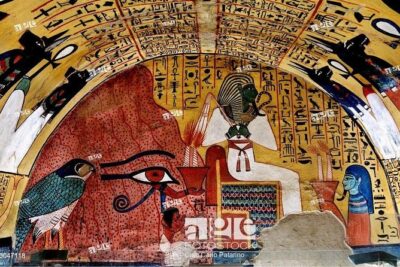
Still, I would give this stop top priority. The decoration inside the tombs is more personal than the grand temple scenes. You see painted gods, rituals, and texts meant to guide a king through the afterlife.
Hatshepsut’s Temple and a queen who ruled Egypt
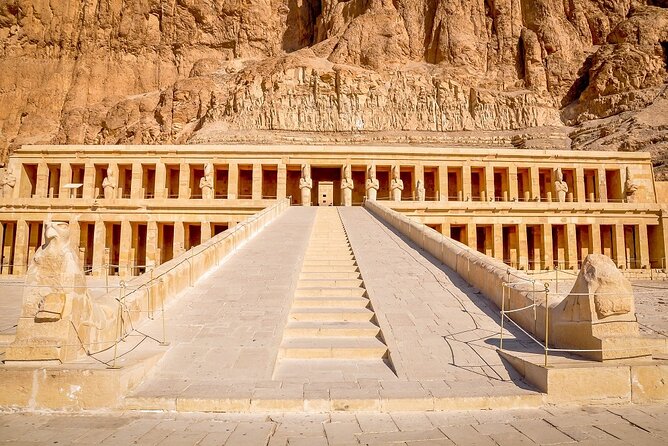
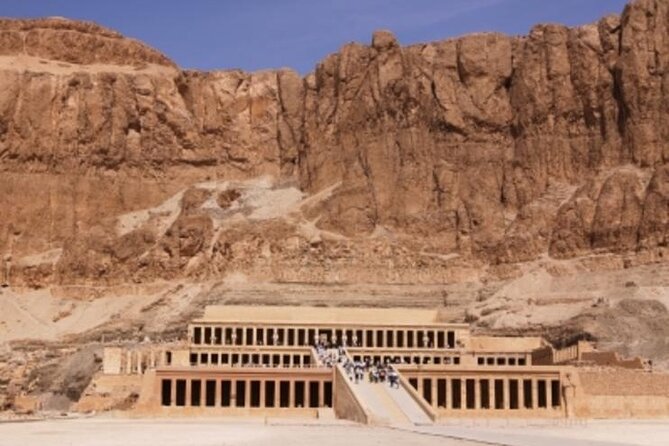
The next major stop is the Temple of Hatshepsut at Deir el-Bahari. You have about 90 minutes here, enough to appreciate the design without turning the visit into a quick photo stop.
Hatshepsut ruled during Egypt’s 18th Dynasty, roughly 3,500 years ago. Her temple rises in three broad levels cut into the cliffs. Long terraces and straight lines give it a different feel from the enclosed temple rooms on the East Bank.
The design is the main reason to pay attention here. The temple uses open terraces, limestone walls, and rows of statues showing Hatshepsut in the form of Osiris. These statues were originally painted, though much of that color has faded or disappeared.
Your Egyptologist guide can help explain the unusual political story behind the monument. Hatshepsut was a female ruler who presented herself with the symbols normally linked to male pharaohs. The temple is not only an architectural site. It is also a carefully built statement of royal authority.
Admission is extra, and you should expect plenty of sun while moving between the terraces. The open layout makes the temple easy to understand, but it offers little shade. A hat and water will make the 90-minute visit easier.
Colossi of Memnon: a short stop with a strange story
The Colossi of Memnon take only about 30 minutes, and admission is free. These two huge seated statues represent Amenhotep III, an 18th Dynasty pharaoh who ruled around 1350 BC.
Each statue reaches about 19 meters high. They are the surviving front figures of a much larger memorial temple that once occupied the area. The temple is gone, but the pair still gives you a clear sense of the scale favored by Egypt’s rulers.
This is a short stop, so do not expect an extended visit. You will have time to look closely, take photographs, and hear the story behind the name Memnon.
The Greeks gave the statues that name after the eastern statue cracked and was said to make a sound at dawn. They connected the sound with Memnon, a legendary warrior calling to his mother. The story is part of the long afterlife of these monuments, which were admired and reinterpreted long after Egypt’s pharaohs were gone.
I like this stop because it breaks up the larger West Bank visits. It is also a useful reminder that famous ancient sites often survive in fragments. You are seeing two statues, not the whole temple, but the scale still comes through.
A completely different sort of day out in Luxor:
- Luxor: Shared Full-Day Tour to Luxor West and East Banks
★ 4.5 · 1,812 reviews - Luxor: Hot Air Balloon Ride over Luxor Relics
★ 4.8 · 1,681 reviews - Luxor Day Tour: Valley of Kings & Queens & Hatchepsut Temples
★ 5.0 · 1,496 reviews - Full Day Tour to East and West Banks of Luxor
★ 5.0 · 1,449 reviews
Karnak Temple: give the largest complex your attention
Karnak gets about 90 minutes, though you could easily spend much longer there. This is a huge collection of temples, columns, courts, and sacred buildings on Luxor’s East Bank.
Construction continued from the Middle Kingdom through the Roman period. Different rulers added their own walls, halls, statues, and inscriptions. That long building process is why Karnak feels less like one single temple and more like a vast religious center that grew over many centuries.
The complex was linked with the Theban religious family of Amun, Mut, and Khonsu. Amun, later connected with Ra as Amun-Ra, was the main god honored here. Mut was his wife, and Khonsu was their son.
Your guide matters greatly at Karnak. Without context, the size can overwhelm you. With an Egyptologist explaining the purpose of the complex, the columns, reliefs, and processional spaces begin to make sense.
The 90-minute slot is useful but tight. Try to stay with the guide during the main explanation, then use any spare minutes for photographs. Admission is not included, and the site involves plenty of walking across open ground.
Of all the stops, Karnak may require the most concentration. It is grand, crowded with layers of construction, and physically spread out. Do not treat it as a quick stop for a single famous view. The value comes from understanding how the religious center changed over time.
Luxor Temple after dark or in daylight
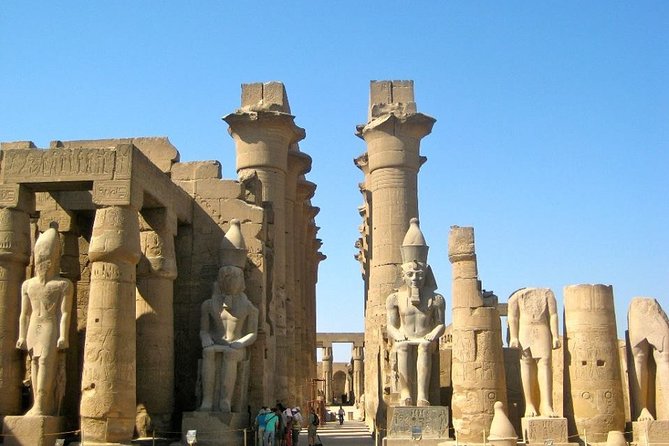
The final main stop is Luxor Temple, with about one hour set aside. Built mainly during Egypt’s 18th and 19th Dynasties, the temple honored Amun-Ra, Mut, and Khonsu, the Theban triad.
Amenhotep III built much of the temple, while Ramses II added the pylon, an open courtyard, and obelisks. Tuthmosis III also contributed to the complex. These layers give the site a different character from Hatshepsut’s more unified temple design.
Luxor Temple sits within the modern city, so it feels closely tied to present-day Luxor. The location helps you see how ancient religious buildings remain part of the city rather than isolated ruins far from daily life.
One hour is enough for the main courtyard, entrance area, columns, and guide commentary. It is not enough for a slow, detailed study of every inscription. I would pay close attention during the explanation, then use the remaining time to take in the scale of the courtyard and the carved surfaces.
Because this is the final major sight, energy can become an issue. By now you will have crossed both banks and visited several large sites. If your group is tired, ask the guide to focus on the parts you care about most. The tour is designed to cover the highlights, not every corner.
What the $40 package really gives you
The $40 price includes more than a simple ride between monuments. You receive:
- Private air-conditioned transfers
- Pickup and return to your Luxor hotel
- Pickup and return to the airport
- An English-speaking Egyptologist guide
- Lunch
- Service charges and taxes
That package is useful if you want one person to coordinate the day. You do not need to bargain with drivers, arrange a restaurant stop, or work out how to cross between the East and West Banks.
The guide is the main value. A good Egyptologist can turn a row of columns into a story about religion, royal power, and construction. Shaaban was praised for giving detailed explanations, answering questions well, and changing the driving plan to fit the group’s wishes. That is exactly the sort of flexibility I want on a long sightseeing day.
Lunch is included, but no details are provided about the restaurant, menu, or dietary options. If you have food restrictions, ask before the tour begins.
The main extra is admission. Every major monument except the Colossi of Memnon lists entry as not included. Tips and additional charges for other languages are also excluded.
Heat, pace, and the private-tour question
This is a serious sightseeing day. The listed stops add up to roughly six hours, before driving, lunch, and ticket arrangements. You will walk through large open areas, climb or descend at tomb entrances, and spend much of the day outside.
The pace should suit someone who wants the major Luxor sights in one day. It is less suitable if you prefer long, slow visits with time for every inscription. The schedule is efficient, but efficiency can feel tiring.
I like the small-group approach because it gives you a chance to ask questions. The information describes the activity as private, while also describing the guide as shared with a group of six to eight. Confirm this point if a fully private guide is important to you.
Most people can take part, according to the tour details. Still, the practical demands are clear: heat, walking, uneven ground, and enclosed tomb spaces. The provider does not give detailed accessibility information, so ask directly if you have mobility concerns.
Who should book this Luxor day tour?
I would recommend it to a first-time Luxor visitor with one full day available. It covers the essential monuments on both sides of the Nile and gives you a guide to connect the pieces.
It is also a good fit if you are arriving at the airport and want pickup handled from the start. Families and small groups may find the private format useful, especially when deciding how long to spend at each stop.
The tour is less ideal for archaeology specialists or repeat visitors who want obscure tombs, long museum time, or a very slow pace. You will see the headline sites, not every corner of ancient Thebes.
Book it if you value organization, air-conditioned transport, and clear explanations. Before paying, confirm the current admission total, the exact group size, and the language supplement if you need a guide in a language other than English. Free cancellation is available until 24 hours before the start time, which gives you some breathing room if your plans change.
Should you book it?
For $40, this is a strong way to cover Luxor’s major sights in one demanding day. The guide, transfers, and lunch make the price useful, and the praise for Shaaban points to the kind of personal service that can improve a packed schedule.
Just treat the advertised price as the tour fee, not the complete day’s cost. Add entrance tickets and tipping, prepare for heat, and confirm the guide arrangement. If you want the classic Luxor experience with less transport hassle, I would book it. If you want leisurely exploration, split the East and West Banks across two days instead.
FAQ
How much does the Luxor day tour cost?
The listed price is $40 per person. Entrance fees, tipping, and additional charges for other languages are not included.
How long does the tour last?
The tour lasts about eight hours.
Does the tour provide hotel pickup?
Yes. Pickup and return are offered from your hotel in Luxor. Airport pickup and drop-off are also listed.
Which attractions are included in the route?
The route includes the Valley of the Kings, Temple of Hatshepsut at Deir el-Bahari, Colossi of Memnon, Karnak Temple, and Luxor Temple.
Are entrance tickets included?
No. Admission fees are not included. The Colossi of Memnon are listed as free, while entry to the other main sites is extra.
Is lunch included?
Yes. Lunch is included in the tour price, though the provided details do not specify the restaurant or menu.
Is the tour private?
The activity is described as private, with only your group participating. The guide information also refers to a small group of six to eight people, so confirm the exact arrangement when booking.
What type of guide is provided?
An English-speaking Egyptologist guide is included. A supplement applies for other languages.
Can I cancel for a full refund?
Yes. You can cancel at least 24 hours before the experience start time for a full refund. Cancellations or changes made less than 24 hours before the start time are not accepted for a refund.
Just added around Luxor
- Private Tour foll day to East and West Banks of Luxor★ 5.0 · 23 reviews
- East and West Bank Luxor★ 5.0 · 23 reviews
- Full Day Tour to Luxor (East & West Bank)★ 5.0 · 23 reviews
- Big brother travel★ 5.0 · 23 reviews
- Luxor Day Tour :Valley of Kings & queen & Hatshepsut & Habu city★ 5.0 · 23 reviews
- Luxor: Scenic Camel or Horse Ride★ 3.9 · 24 reviews
- From Cairo: 4-Day Nile Cruise from Aswan to Luxor with Meals★ 4.4 · 24 reviews
- Traditional Egyptian Breakfast at the AlHabib Arabian Horse Farm★ 5.0 · 24 reviews
Luxor Tours, compared.
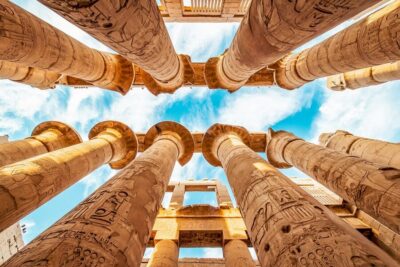
Luxor Valley of the Kings & Tutankhamun Tomb Trip
Read our review →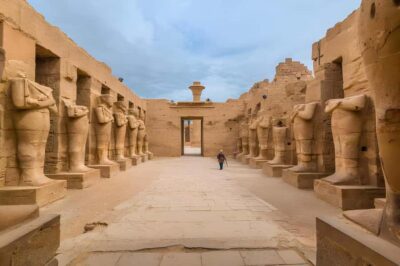
Luxor Day Trip from Hurghada Small Group & Tutankhamun Tomb
Read our review →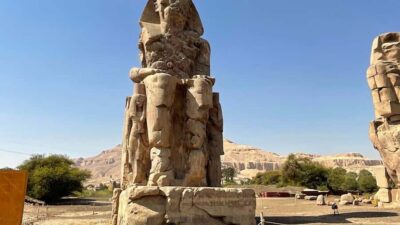
Shared Full-Day Tour to Luxor West and East Banks
Read our review →
Luxor Day Tour: Valley of Kings & Queens & Hatchepsut Temples
Read our review →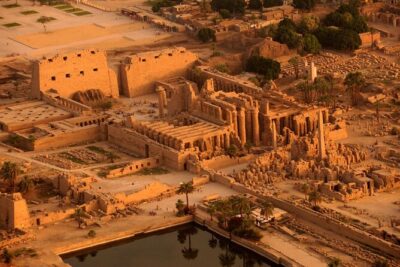
Full Day Tour to East and West Banks of Luxor
Read our review →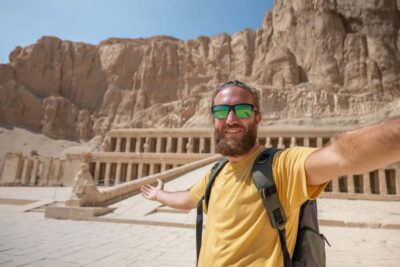
Valley of the Kings and Hatshepsut Temple Day Tour
Read our review →
2-Day Luxor Tour with Hotel, Balloon, & Boat Ride
Read our review →Browse the lists this tour appears in