
Reviewed · FULL-DAY
Full-Day East and West Luxor Private Tour
Ancient Egypt rewards an early start. This private Luxor tour packs the city’s greatest monuments into one long day, taking you from the royal tombs of the West Bank to the grand temples of the East Bank. I like the private vehicle and flexible pace, and I like having an Egyptologist guide to explain what you are seeing rather than simply pointing at old stones. The main caution is cost clarity: entrance fees are extra, lunch is listed as excluded despite some promotional wording, and a shopping stop may be offered.
You will spend about seven to eight hours on the road and at the monuments, with hotel or cruise-ship pickup included. The route covers the Valley of the Kings, Hatshepsut’s temple, the Colossi of Memnon, Karnak Temple, and Luxor Temple. It is a strong choice if you have only one full day, but the schedule is busy and the sun can be fierce.
In This Review
- Five things to know before booking
- Why this route works for a one-day Luxor visit
- Valley of the Kings: colorful tombs below the desert hills
- Hatshepsut’s temple and the story of a female pharaoh
- Colossi of Memnon: a quick stop with a big visual payoff
- Karnak Temple: the grandest part of the East Bank
- Luxor Temple: a fitting final stop
- The private vehicle and guide make the biggest difference
- The $52 price is attractive, but not the final bill
- Who will get the most from this tour
- Booking advice for a smoother day
- Should you book the Full-Day East and West Luxor Private Tour?
- FAQ
- How long does the tour last?
- Is hotel pickup included?
- Can cruise-ship passengers join the tour?
- Is this a private tour?
- Are entrance fees included?
- Is lunch included?
- Is a vegetarian meal available?
- Is airport pickup included?
Five things to know before booking
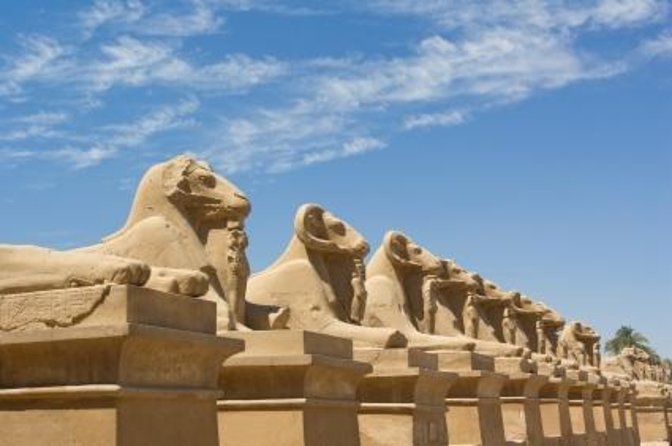
- Five major sights in one day: The route joins Luxor’s West Bank tombs with its East Bank temples, saving you from arranging separate outings.
- Private guiding: Only your group participates, so you can ask questions and spend more time at the places that interest you.
- Entrance fees are extra: The advertised $52 price covers transport, bottled water, and the guide, but not monument tickets.
- Lunch needs clarification: The details say lunch is not included, although some descriptions and past arrangements refer to a buffet lunch.
- Guide quality matters: Guides named in positive accounts include Marwa, Mahmoud Nafee, Mo, and Smiley, while complaints focus on dishonesty and unwanted shopping pressure.
Why this route works for a one-day Luxor visit
Luxor is split by the Nile into two very different sightseeing areas. The West Bank is the world of tombs and funerary temples. The East Bank is where the great temples of daily worship and royal ceremony are found.
Seeing both sides in one day gives you a useful picture of ancient Thebes. You begin with the dead kings and their hidden burial places, then move toward the public temples built for gods, festivals, and royal power. That contrast is one of the best reasons to take this route.
A private tour also helps with the awkward parts of Luxor sightseeing. You do not need to work out separate transport between five widely spaced sites, and you can return to an air-conditioned vehicle after time in the heat. Bottled water is included, which is a small but welcome detail in a place where you may spend hours outdoors.
The tradeoff is time. Seven to eight hours sounds generous, but the West Bank alone can absorb much of the morning. Add the drive to the East Bank, lunch if arranged, and two major temple complexes, and you will need to keep moving.
More things to do in Luxor:
- Hurghada: Luxor Valley of the Kings & Tutankhamun Tomb Trip
★ 4.7 · 13,208 reviews - Luxor Day Trip from Hurghada Small Group & Tutankhamun Tomb
★ 4.8 · 5,366 reviews - Hot Air Balloon Ride in Luxor Egypt with Transfers Included
★ 5.0 · 4,319 reviews
Valley of the Kings: colorful tombs below the desert hills
The Valley of the Kings receives about two hours in the planned schedule. That is sensible, since the area can easily fill a morning by itself.
This dry valley was used for royal burials, including tombs associated with Thutmose I, Thutmose III, Tutankhamun, Ramesses VI, Merenptah, and Amenhotep II. The famous names draw people in, but the real pleasure is walking down into the decorated chambers and seeing how much color has survived.
Your admission ticket is not included. The exact number of tombs you can enter depends on the ticket arrangements and any special ticket required for Tutankhamun’s tomb, so ask your guide before you commit to the day’s order. Do not assume that every famous tomb is covered by the basic entry.
The Valley of the Kings is not a single grand building. It is a spread of tomb entrances in a stark, sun-baked setting. Some visitors expect one dramatic monument and are surprised by the walking, heat, and practical limits of visiting several interiors. I would bring a hat, wear sturdy shoes, and save some energy for Hatshepsut and the East Bank temples.
The guide can add real value here. Tomb decoration has a visual code, with scenes connected to the afterlife, gods, and the king’s passage into the next world. A good explanation helps you see why a painted wall matters instead of treating each chamber as another dark room.
Hatshepsut’s temple and the story of a female pharaoh
The next stop is the Temple of Hatshepsut at Deir el-Bahari, planned for about one hour. Its terraces rise against the cliffs, giving the site a completely different feel from the underground tombs.
Hatshepsut ruled Egypt for roughly two decades during the 18th Dynasty. She was the daughter of Thutmose I and one of the few women to rule Egypt as pharaoh. Her temple was built to project authority, and its broad terraces and formal lines make that political message easy to understand.
This is a place where your guide’s explanation can shape the visit. Hatshepsut’s position was unusual, and the story involves royal identity, succession, and how later rulers treated her memory. You will get more from the reliefs and statues if the guide points out what to look for.
One hour is enough for a focused visit, but not for a slow study of every wall. If Hatshepsut is a special interest, tell your guide early. The private format gives you a better chance of adjusting the pace than a large group tour would.
The open setting also means little shade. By this point, the day may already feel hot, particularly if you lingered in the Valley of the Kings. Keep water with you and use the vehicle’s cool interior as a proper break, not just a place to sit for two minutes.
Colossi of Memnon: a quick stop with a big visual payoff
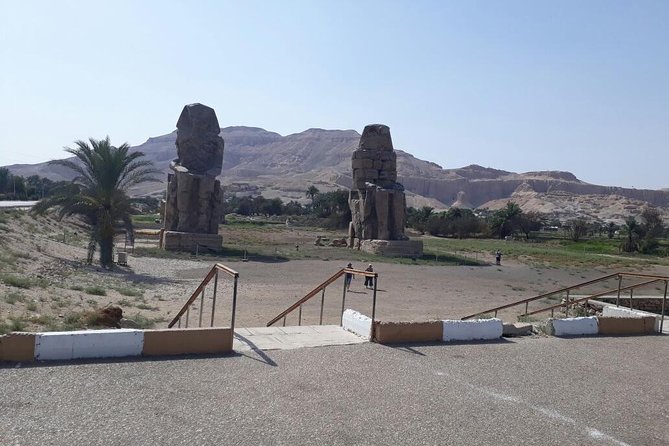
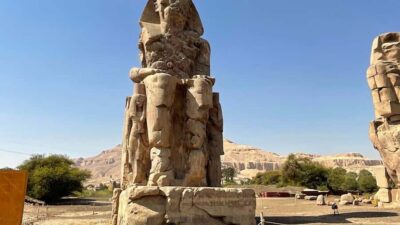
The Colossi of Memnon are part of the West Bank portion of the day, although the supplied schedule does not assign a separate duration. In practice, this is generally treated as a short photo and explanation stop.
The two huge seated figures once guarded the entrance to a much larger temple complex. Even with the surrounding ruins less complete than at Karnak or Luxor Temple, the statues give you an immediate sense of royal scale.
This stop works well between the larger monuments. You can see the colossi without spending the energy required for a full temple visit, and the open view makes a useful pause before crossing back toward the East Bank.
Do not expect a long exploration here. The value is visual and historical context, not a lengthy circuit. If your day is running late, this is one of the places where you should ask how much time is planned, since every extra minute affects Karnak and Luxor Temple.
A few more Luxor trips worth weighing up
- Luxor: Shared Full-Day Tour to Luxor West and East Banks
★ 4.5 · 1,812 reviews - Full Day Tour to East and West Banks of Luxor
★ 5.0 · 1,449 reviews - Luxor : Full Day Tour to Luxor West and East Banks & Lunch
★ 5.0 · 870 reviews - Full Day Tour of Luxor West Bank Temples and Tombs (Private)
★ 5.0 · 722 reviews
Karnak Temple: the grandest part of the East Bank
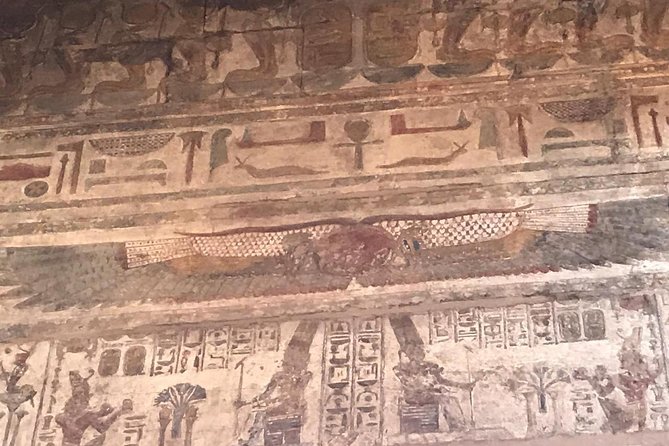
Karnak receives about two hours, and it deserves that time. This is not one compact temple but a vast religious complex dedicated mainly to Amun, his wife Mut, and their son Khonsu.
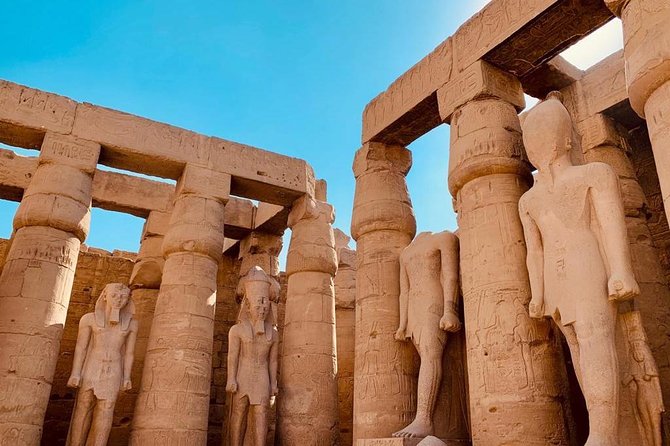
The scale can be hard to grasp at first. You move through courts, columns, gateways, and open spaces built and altered by successive rulers. The famous Hypostyle Hall, with its forest of massive columns, is the kind of place where a guide helps you stop, look up, and understand the building’s purpose.
Karnak was a center of worship and royal display, not simply a tomb or memorial. That makes it an important counterpoint to the West Bank. Here, the ancient state presented its gods and kings to the public through processions, offerings, and monumental architecture.
Two hours allows a useful overview. It may not allow every corner or every explanation in equal detail, especially if the tour has lost time earlier. Ask your guide to prioritize the main court, the large columned hall, and the most important sacred areas.
Admission is extra, so include this site when calculating the real cost of the day. If you are watching your budget, do not judge the $52 price without adding all entrance tickets and any lunch charge.
Luxor Temple: a fitting final stop
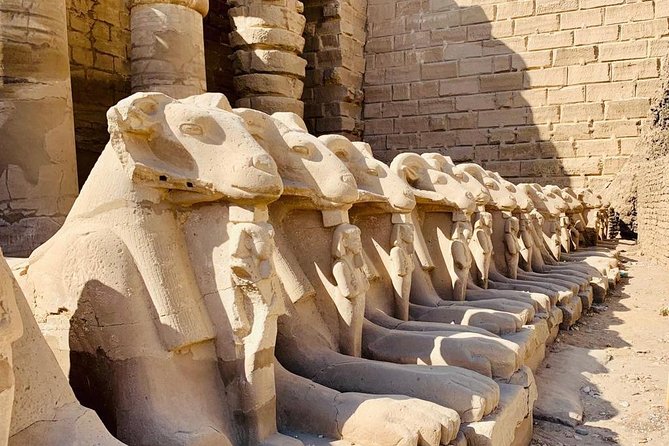
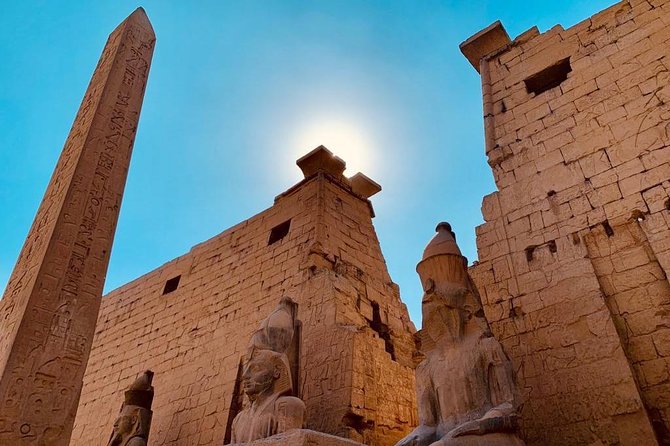
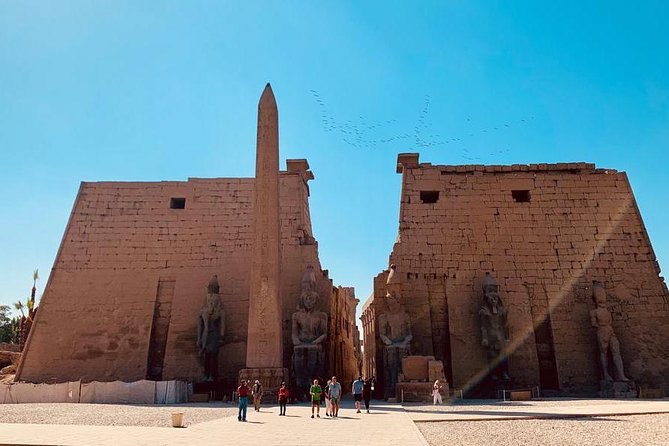
The day ends at Luxor Temple, which was built under Amenhotep III during the New Kingdom and completed in part by Ramesses II. Its position in modern Luxor makes it feel more connected to the living city than the remote West Bank sites.
Luxor Temple was linked to royal ceremonies and the annual Opet Festival, when the gods’ images were carried between major religious centers. Your guide can explain how the temple’s spaces relate to kingship, worship, and public ritual.
This is often a rewarding final stop because the architecture is easy to read after the more sprawling Karnak visit. You can focus on the entrance, statues, columns, and processional areas without trying to absorb an entire valley of tombs.
The schedule places Karnak and Luxor Temple together under roughly two hours, so the timing may be tight if both are visited in depth. If you care more about temples than tombs, say so at the start. A private tour should allow some discussion of priorities, though the total day still has limits.
As with the other monuments, admission is not included. The advantage of visiting Luxor Temple at the end is convenience: you finish in the East Bank sightseeing zone rather than making another long detour.
The private vehicle and guide make the biggest difference
The transport is by private vehicle with air conditioning, hotel pickup, hotel drop-off, and bottled water. That matters in Luxor. You will be moving between exposed archaeological sites, and a cool vehicle gives you a place to recover between stops.
A private tour also means you are not tied to the interests or pace of strangers. You can ask for more explanation at a tomb, move through a temple more quickly, or request a short pause if the heat catches up with you. The tour requires at least two people per booking, and a $10 cash single supplement applies for one person during the tour.
Guide quality appears to be the most important variable. Positive experiences specifically praise Marwa, Mahmoud Nafee, Mo, and Smiley. Marwa is described as patient, helpful, and able to answer questions about both the sites and Egypt more broadly. Mahmoud Nafee is praised for making a one-day visit feel productive, while Mo is singled out for giving a complete tour. Smiley and the driver working with him are praised for punctuality and covering the main sights efficiently.
That said, you should set expectations clearly at pickup. Ask which monuments are included in the plan, how much time you will have at each, and if any shopping stop is proposed. A few accounts describe pressure to buy alabaster or other goods at inflated prices. You are allowed to say no. A souvenir stop should never be treated as part of the archaeological experience.
One account also describes crossing the Nile by boat for an extra charge. A river crossing is not listed among the standard inclusions, so ask about any extra transport cost before agreeing to it.
The $52 price is attractive, but not the final bill
At $52 per person, the tour is priced well for a private day with a guide and vehicle. The value is strongest for two people who want door-to-door transport and do not want to arrange separate rides across Luxor.
The price includes:
- Private vehicle transport
- Hotel or cruise-ship pickup and drop-off
- A qualified Egyptologist guide
- Bottled water
It does not include:
- Entrance tickets
- Lunch
- Airport pickup or drop-off
- The $10 cash single supplement for one person
The lunch information needs special attention. The experience details say lunch is excluded, yet another description presents lunch as an included feature, and some arrangements have involved a buffet meal. The safest approach is to assume lunch is not included unless the operator confirms it in writing before the day begins. A vegetarian option is available if requested at booking.
The same caution applies to shopping and optional Nile transport. The low headline price is appealing, but you should make your decision using the full expected cost, not just the advertised base amount.
Who will get the most from this tour
I would choose this tour if you have one full day in Luxor and want the major sights handled in a single run. It suits couples, families, and small private groups who value flexibility more than a slow, specialist visit to one monument.
It is also useful for cruise-ship passengers, provided you give the ship name, docking time, disembarkation time, and re-boarding time when booking. That information lets the operator judge whether the schedule fits your time in port.
The tour is less suitable if you want to spend half a day studying tomb art or photographing one temple at leisure. Five major sites create a good first look, but the pace is necessarily active.
Most people can participate, according to the supplied information, but the route includes outdoor walking, uneven archaeological ground, stairs or slopes at some sites, and strong sun. If you have mobility concerns, ask the operator for more detail before booking rather than assuming a private vehicle removes all walking.
Booking advice for a smoother day
Confirm the following before you go:
- The exact entrance fees and which tombs are planned
- Whether lunch is included or paid separately
- The guide’s name and language
- Any planned shopping stop
- Any extra charge for a Nile boat crossing
- The pickup time and return plan
- Cruise-ship docking and re-boarding details, if relevant
Free cancellation is available if you cancel at least 24 hours before the start time. Changes or cancellations made inside that period are not accepted for a refund.
A private tour gives you a voice, so use it. Tell the guide if you want more time with history, photography, tombs, temples, or local food. Also agree early that shopping is optional. That simple conversation can prevent the main complaint associated with this experience.
Should you book the Full-Day East and West Luxor Private Tour?
Book it if your time is limited and you want Luxor’s essential sights in one organized day. The combination of a private car, hotel pickup, guide, and five major monuments offers good value at $52 before tickets and food.
I would book with two conditions: confirm the lunch arrangement and make your position on shopping clear. I would also ask for a guide such as Marwa, Mahmoud Nafee, Mo, or Smiley if the operator can accommodate that request, though guide assignment cannot be guaranteed from the supplied information.
For a first visit, this is an efficient and worthwhile introduction to Luxor. For a second visit, or for anyone who prefers slow archaeology, a shorter private tour focused on fewer sites may be the better use of your day.
FAQ
How long does the tour last?
The tour lasts approximately seven to eight hours.
Is hotel pickup included?
Yes. Pickup and drop-off at your hotel are included.
Can cruise-ship passengers join the tour?
Yes. Cruise-ship passengers can book, but they must provide the ship name, docking time, disembarkation time, and re-boarding time when booking.
Is this a private tour?
Yes. Only your group participates in the activity.
Are entrance fees included?
No. Entrance fees for the Valley of the Kings, Hatshepsut’s temple, Karnak Temple, Luxor Temple, and other monuments are not included.
Is lunch included?
The supplied details state that lunch is not included, although some tour information refers to lunch or a buffet meal. Confirm the arrangement with Al Ragaa Tours before the tour.
Is a vegetarian meal available?
Yes. A vegetarian option is available if you request it when booking.
Is airport pickup included?
No. Airport pickup and drop-off are not included.
Just added around Luxor
- Private Tour foll day to East and West Banks of Luxor★ 5.0 · 23 reviews
- East and West Bank Luxor★ 5.0 · 23 reviews
- Full Day Tour to Luxor (East & West Bank)★ 5.0 · 23 reviews
- Big brother travel★ 5.0 · 23 reviews
- Luxor Day Tour :Valley of Kings & queen & Hatshepsut & Habu city★ 5.0 · 23 reviews
- Luxor: Scenic Camel or Horse Ride★ 3.9 · 24 reviews
- From Cairo: 4-Day Nile Cruise from Aswan to Luxor with Meals★ 4.4 · 24 reviews
- Traditional Egyptian Breakfast at the AlHabib Arabian Horse Farm★ 5.0 · 24 reviews
Full-Day, compared.
Shared Full-Day Tour to Luxor West and East Banks
Read our review →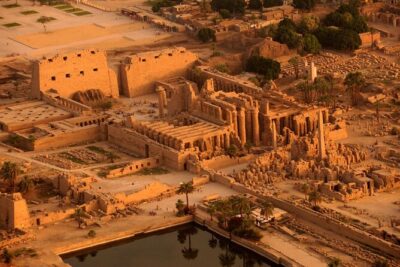
Full Day Tour to East and West Banks of Luxor
Read our review →
Private Full-Day Tour of Historical Alexandria
Read our review →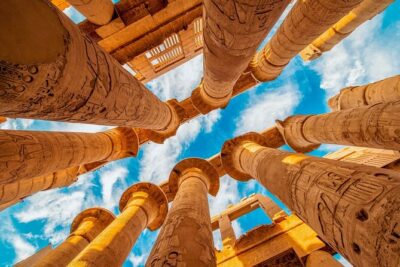
Full Day Tour to Luxor West and East Banks & Lunch
Read our review →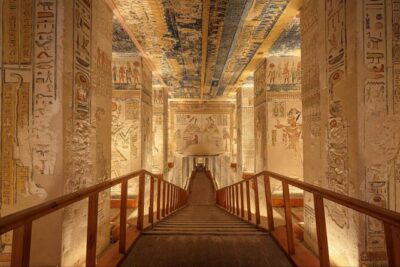
Full Day Tour of Luxor West Bank Temples and Tombs (Private)
Read our review →Browse the lists this tour appears in