
Reviewed · FULL-DAY
Private Full-Day Luxor Highlights East and West Banks
Ancient Egypt rewards an early start. This private Luxor day brings the West Bank tombs and East Bank temples into one well-planned outing, with a private Egyptologist guide, lunch, and hotel pickup included. I like the chance to see four royal tombs at the Valley of the Kings, and I like having time to explore after the guide explains each site. The main catch is that entrance fees are extra, so the $65 price is not your final cost.
The day covers a lot in roughly eight hours, from Tutankhamun’s mummy to Karnak’s giant column hall. Guides such as Mahamoud, Ameen, Hassan, Ragab, Khalid, Hamdee, and Abdul have earned particular praise for clear explanations and a relaxed pace. I would, however, ask in advance about any shopping stop, since one visitor found a stone shop uncomfortable and pressured.
In This Review
- Key points to know before you book
- Why this private Luxor day works
- Starting on Luxor’s West Bank
- Inside the Valley of the Kings
- The optional visit to Tutankhamun’s tomb
- Hatshepsut’s temple and the Colossi of Memnon
- Lunch on the West Bank
- Karnak, the grand finale of the East Bank
- Luxor Temple after Karnak
- What the guide adds to the day
- Price, extra costs, and possible shopping stops
- Who should book this Luxor experience?
- Should you book it?
- FAQ
- What time does the tour start?
- How long does the tour last?
- Are entrance fees included?
- Is lunch included?
- Is hotel transportation included?
- Is this a private tour?
Key points to know before you book
- Four royal tombs are planned at the Valley of the Kings: Ramses IV, Ramses III, Merenptah, and another tomb selected by the guide or site conditions.
- Tutankhamun’s tomb costs extra: the optional admission is listed as 300 EGP, and it gives you a look at the young king’s mummy.
- The private format helps with pacing: your group travels alone, and the guide can explain the monuments before giving you time for photographs.
- Both banks are covered in one day: Hatshepsut, the Colossi of Memnon, Karnak, Luxor Temple, and the Avenue of Sphinxes all fit into the route.
- Lunch and hotel transfers are included: transport is by air-conditioned vehicle, with pickup and drop-off at Luxor hotels.
- Allow extra money for tickets and tips: the base fare is attractive, but the main monuments are not included in the price.
Why this private Luxor day works
Luxor can feel like two separate trips. The West Bank is a world of burial sites, cliffs, and mortuary temples. Across the Nile, the East Bank focuses on grand temples built for worship and royal ceremony. This tour links the two sides without making you arrange taxis, negotiate each transfer, or figure out which ticket window comes next.
The private setup is the real advantage. Your guide can adjust the amount of explanation, slow down for photographs, and answer questions without a large group waiting. Several comments praise guides for giving a clear talk first, then allowing free time to look around. That is the right method at Egyptian monuments, where too much information can blur together.
The listed duration is about eight hours, while the itinerary also describes a seven-hour guided visit. Treat the day as a full morning and afternoon commitment, not a precise minute-by-minute schedule. There are many stops, and site traffic, ticket lines, lunch, and time inside the tombs can change the pace.
More things to do in Luxor:
- Hurghada: Luxor Valley of the Kings & Tutankhamun Tomb Trip
★ 4.7 · 13,208 reviews - Luxor Day Trip from Hurghada Small Group & Tutankhamun Tomb
★ 4.8 · 5,366 reviews - Hot Air Balloon Ride in Luxor Egypt with Transfers Included
★ 5.0 · 4,319 reviews
Starting on Luxor’s West Bank
Pickup begins at about 8:00 a.m. from your Luxor hotel. You travel in a private, air-conditioned vehicle with a driver and guide, which matters because the West Bank and East Bank sights are spread out. One account describes an SUV, while another praises the driver for handling rougher roads safely.
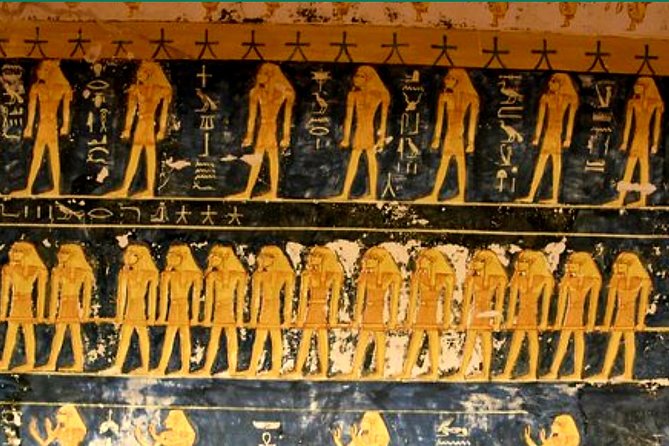
The West Bank is often the emotional center of the day. Here, the focus shifts from huge public monuments to narrow corridors and painted chambers made for the dead. Your guide helps explain why the tombs were built, how the decoration worked, and what the scenes meant for a pharaoh’s journey into the next world.
The route lists additional West Bank places such as the Tombs of the Nobles, Al Asasif, the Temple of Merenptah, the Temple of Ramesses II, the Mortuary Temple of Seti I, Carter House, and the Tombs of Ramesses VI and IX. The detailed schedule gives the main time to the Valley of the Kings and Hatshepsut, so you should confirm which secondary sites will be visited on your date.
Inside the Valley of the Kings
The Valley of the Kings is not a single tomb but a royal cemetery with separate underground passages cut into the hills. The standard plan includes four royal tombs, with admission tickets paid separately. The exact choice can depend on what is open and on the guide’s judgment.
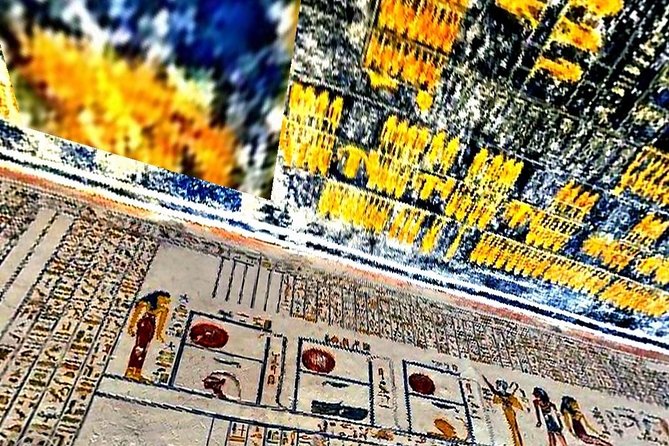
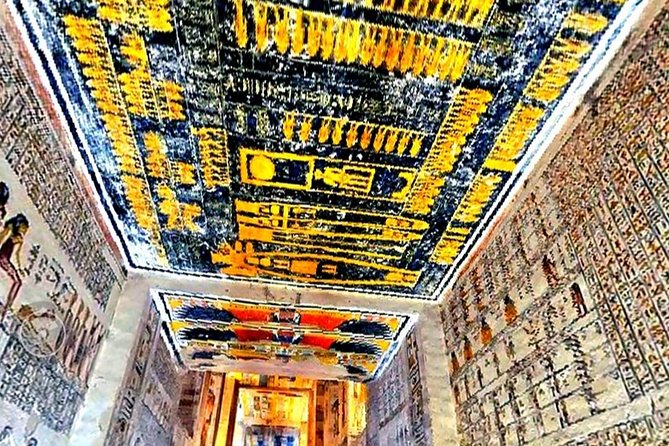
Ramses IV is a strong first stop. Its walls carry scenes from several religious books, including the Litany of Ra, the Book of the Dead, the Book of Caverns, and the Book of Amduat. In the burial chamber, you can see a rose-colored granite sarcophagus, while the ceiling shows the goddess Nut swallowing and later giving birth to the sun.
Ramses III, listed as KV 11, offers a different feel. Its painted reliefs include ritual texts and scenes of the king before the gods. Small side rooms show unusual secular subjects, including foreign tribute, boats, military equipment, imported pottery, and blind harpists. The final detail explains its alternative name, the Tomb of the Harpers.
The Tomb of Merenptah is also included in the plan. Merenptah was a son of Ramses II, and his burial place is notable for its tall corridors and rooms, along with a simpler arrangement of side chambers than some earlier royal tombs. The tomb was found by Howard Carter in 1903.
The schedule gives around 15 minutes each for Ramses III and Merenptah, and about 25 minutes for Ramses IV. That is enough for an introduction and a focused look, but not for a slow study of every painted wall. If you love ancient art, tell your guide early so the private format can work in your favor.
The optional visit to Tutankhamun’s tomb
Tutankhamun’s tomb is a brief but memorable addition. The optional ticket is listed at 300 EGP, and the visit takes about 15 minutes. Inside, you can see the king’s royal mummy in the tomb itself.
The chamber is not the same as the spectacular display of objects found in the tomb, most of which are associated with museums rather than the burial chamber. The appeal here is direct contact with the burial site of Egypt’s most famous young king. Tutankhamun became king at about age 10 and died at about 19, making the small tomb and the preserved mummy especially striking.
I would decide before the tour begins if this matters to you. It is an extra fee, but the visit is short and easy to fit into the day. If you prefer larger tombs with more wall decoration, Ramses IV or Ramses III may offer more visual material.
A few more Luxor trips worth weighing up
- Luxor: Shared Full-Day Tour to Luxor West and East Banks
★ 4.5 · 1,812 reviews - Full Day Tour to East and West Banks of Luxor
★ 5.0 · 1,449 reviews - Luxor : Full Day Tour to Luxor West and East Banks & Lunch
★ 5.0 · 870 reviews - Full Day Tour of Luxor West Bank Temples and Tombs (Private)
★ 5.0 · 722 reviews
Hatshepsut’s temple and the Colossi of Memnon
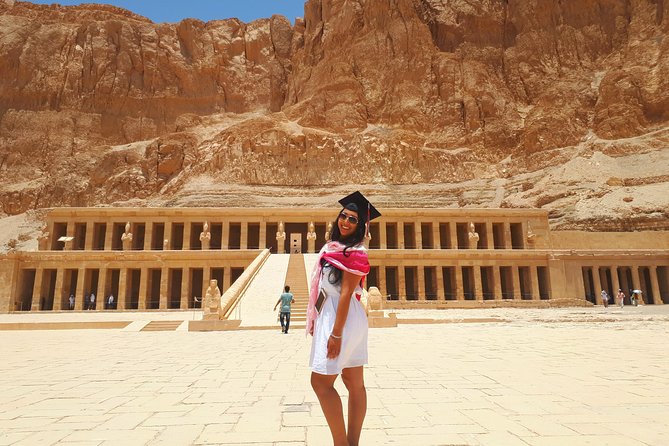
After the Valley of the Kings, the route continues to the Temple of Hatshepsut at Deir el Bahari. The temple rises in broad terraces against the cliffs, creating a sharp contrast with the underground tombs. It was built for Hatshepsut, the woman who ruled Egypt as pharaoh, and she is also connected by family line to Tutankhamun’s dynasty.
The planned visit lasts about an hour. Your guide can put Hatshepsut’s rule into context, then give you room to examine the terraces, reliefs, and views toward the surrounding cliffs. The site is exposed, so bring water, a hat, and shoes that handle uneven ground.
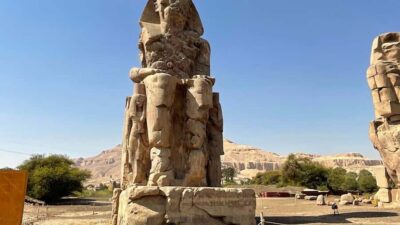
The Colossi of Memnon takes only about 10 minutes. These two huge seated statues date from the reign of Amenhotep III. It is a quick photo stop rather than a long archaeological visit, but the scale gives you a useful sense of how royal monuments once announced power from a distance.
Lunch on the West Bank
Lunch is included, which makes the day easier and protects your sightseeing time. One especially appealing account describes a local restaurant on the West Bank beside the Nile, while another calls the meal excellent. A separate comment found lunch basic, so expectations should remain sensible rather than restaurant-focused.
The best value here is convenience and a pause in the middle of a demanding day. You can ask where lunch will be served and what is included if food matters to you. One account also mentions an unexpected boat ride across the Nile after lunch, but that should not be treated as a guaranteed part of every departure because it is not listed among the inclusions.
Karnak, the grand finale of the East Bank
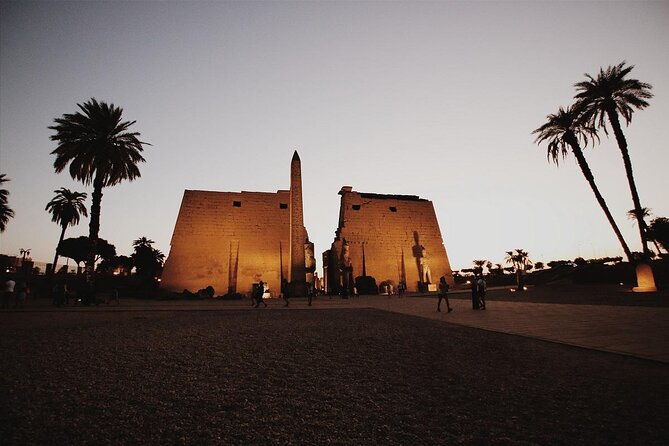
Karnak is the largest and most demanding stop. The itinerary assigns about an hour to the main complex and also lists separate time for the Temple of Amun, with a total of roughly two hours in that area. The schedule names the Avenue of Sphinxes, the Hypostyle Hall, obelisks, the sacred lake, a granite scarab, and temple areas linked to Amun.
The Hypostyle Hall is the visual centerpiece. Its 134 giant columns create a forest of stone, with carved and painted surfaces rising above you. The complex grew over many reigns, so the guide’s help is valuable here. Without context, the courtyards, pylons, sanctuaries, obelisks, and side chapels can seem like one enormous stone puzzle.
Look for the obelisks associated with Hatshepsut and Thutmose I, then continue toward the Temple of Amun. Lotus and papyrus designs connect the architecture to Egyptian religious ideas, while the sacred lake and granite scarab add smaller details to a huge site.
The route also lists the Temple of Ramesses III, another Temple of Amun stop, and the Obelisk of Thutmose I. These may appear as separate points in the schedule, but they are all part of the Karnak visit rather than distant stops. That distinction helps you understand why the day can feel full even when you are not constantly getting back in the vehicle.
Luxor Temple after Karnak
Luxor Temple provides a more compact finish. Dedicated to the Theban Triad of Amun-Ra, Mut, and Khonsu, it includes large statues of Ramses the Great and a strong sequence of courtyards, columns, and monumental entrances.
The planned visit takes about an hour. Luxor Temple is easier to grasp than Karnak because the layout is smaller, but it still benefits from a guide who can explain the religious purpose of the complex and the role of royal imagery.
The Avenue of Sphinxes once connected Luxor Temple with Karnak over about three kilometers. Only a shorter section is available to see today, but it remains an impressive link between the two major temple sites. The listed visit takes about 15 minutes, making it a good final look rather than a separate long excursion.
What the guide adds to the day
The strongest part of this experience is the human explanation. Guides named in the feedback include Mahamoud, Ameen, Hassan, Ragab, Khalid, Hamdee, Abdul, and Mohamed. Praise centers on clear English, strong Egyptology, patience, humor, and the ability to explain first, then step back while you explore.
Ragab is noted for explaining the monuments well and allowing plenty of free time. Hassan is described as witty and well informed. Khalid is praised for answering questions in detail, while Hamdee is appreciated for reading the group’s pace instead of flooding everyone with facts. Abdul is described as friendly with children and able to offer restoration insights through his work with a site restoration team.
That range matters. A private guide is not automatically a great guide, but the best version of this tour gives you interpretation without turning every stop into a lecture. If you have children, older relatives, or different interests within your group, tell the guide what you need.
Price, extra costs, and possible shopping stops
At $65 per person, the tour offers good value if you want private transport, a guide, lunch, and hotel transfers in one package. It is especially useful for a short Luxor stay, since arranging the East and West Banks independently can take time and local negotiation.
The price does not cover entrance fees. Tickets for the Valley of the Kings, Hatshepsut, Karnak, Luxor Temple, and other paid sites come from your budget. Tutankhamun’s tomb is optional and listed at 300 EGP. Gratuities are also not included, though they are recommended.
Ask for the total ticket plan before you start. This prevents the $65 headline price from creating the wrong expectation. You may also want to ask directly if the day includes a stone or alabaster shop. One visitor had a very unpleasant experience with unclear prices and strong pressure to buy. You can politely decline a shopping stop, and you should never feel obliged to purchase anything.
Who should book this Luxor experience?
I would choose this tour if you want the major sights in one day and prefer not to manage transport. It suits first-time visitors, families, couples, and small groups that want a private pace rather than a bus schedule.
It also works well for anyone who learns best through stories. The monuments are enormous, but their meaning is easier to grasp when a guide points out the difference between a tomb, a mortuary temple, and a temple built for active worship.
I would hesitate if you dislike a packed schedule or want long, quiet periods at each tomb. Four royal tombs, Hatshepsut, Memnon, Karnak, Luxor Temple, and the Avenue of Sphinxes add up to a demanding day. I would also compare the final cost after entrance fees, especially if you are watching your budget closely.
Hotel pickup and drop-off in Luxor are included, and confirmation is supplied at booking. Most people can take part, and only your group participates. Free cancellation is available up to 24 hours before the start time, which gives you some useful flexibility.
Should you book it?
Book this tour if your priority is efficient access to Luxor’s essential monuments with a private guide. The combination of four royal tombs, Hatshepsut, Karnak, Luxor Temple, lunch, and transfers is hard to beat for a single day at this price.
Before paying, budget for every entrance ticket, decide on Tutankhamun’s tomb, and ask about shopping stops. If you confirm those details and accept the quick pace, this is a strong choice for seeing both banks without wasting a day on transport planning.
FAQ
What time does the tour start?
The stated start time is 8:00 a.m., with pickup from your hotel in Luxor.
How long does the tour last?
The experience lasts approximately eight hours. The guided portion is also described as about seven hours, so the exact length can vary with site visits, lunch, and transport.
Are entrance fees included?
No. All entrance fees are paid separately. Tutankhamun’s tomb is optional and is listed at 300 EGP.
Is lunch included?
Yes. Lunch is included in the tour price.
Is hotel transportation included?
Yes. Pickup and drop-off at Luxor hotels are included, with transport in an air-conditioned vehicle.
Is this a private tour?
Yes. Only your group participates, and a qualified Egyptologist guide accompanies you.
Just added around Luxor
- Private Tour foll day to East and West Banks of Luxor★ 5.0 · 23 reviews
- East and West Bank Luxor★ 5.0 · 23 reviews
- Full Day Tour to Luxor (East & West Bank)★ 5.0 · 23 reviews
- Big brother travel★ 5.0 · 23 reviews
- Luxor Day Tour :Valley of Kings & queen & Hatshepsut & Habu city★ 5.0 · 23 reviews
- Luxor: Scenic Camel or Horse Ride★ 3.9 · 24 reviews
- From Cairo: 4-Day Nile Cruise from Aswan to Luxor with Meals★ 4.4 · 24 reviews
- Traditional Egyptian Breakfast at the AlHabib Arabian Horse Farm★ 5.0 · 24 reviews
Full-Day, compared.
Shared Full-Day Tour to Luxor West and East Banks
Read our review →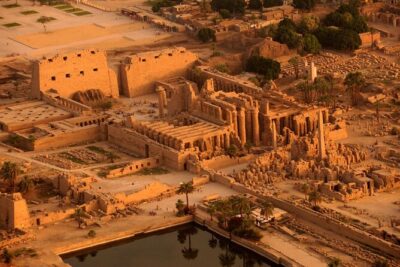
Full Day Tour to East and West Banks of Luxor
Read our review →

Private Full-Day Tour of Historical Alexandria
Read our review →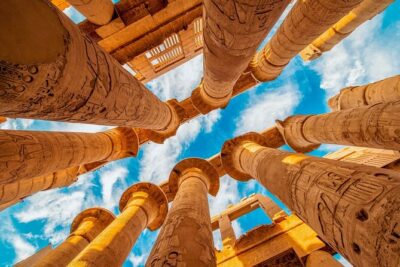
Full Day Tour to Luxor West and East Banks & Lunch
Read our review →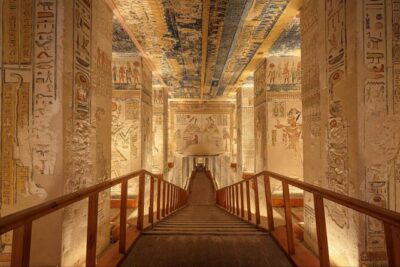
Full Day Tour of Luxor West Bank Temples and Tombs (Private)
Read our review →Browse the lists this tour appears in