
Reviewed · ABU SIMBEL TOURS
Private Tour: Abu Simbel by Minibus from Aswan
Go for the statues, stay for the story. This private Abu Simbel tour takes you from Aswan to two of Egypt’s most astonishing ancient monuments, with an Egyptologist guide, hotel or port pickup, and free time inside both temples. I like the personal setup, since your own group travels together, and I like the chance to choose a departure time rather than follow a fixed public schedule.
The main drawback is the road. You spend about three hours each way crossing the desert, and the time at Abu Simbel can feel short if the convoy runs late. At $231.42 per person, this is not the cheapest way to visit, but private transport and direct pickup can make the price worthwhile for a small group with only one day in Aswan.
In This Review
- Key points to know before you book
- Why Abu Simbel deserves a full day from Aswan
- A private minibus makes the long road easier
- Choosing between a 4 a.m. start and a later departure
- Facing the Great Temple of Ramses II
- The smaller Temple of Hathor and Nefertari
- The 1968 relocation is almost as impressive as the temples
- How much time will you really have?
- Is the $231.42 price fair?
- Who will enjoy this Abu Simbel trip most?
- Should you book it?
- FAQ
- How long does the Abu Simbel tour take?
- How long is the drive from Aswan to Abu Simbel?
- Which temples are included?
- Is transportation included?
- Is the tour private?
- Can I choose the departure time?
- Can the guide enter the temples with me?
- Is the visitor center included?
- What is the cancellation policy?
Key points to know before you book
- The temples are the reason to go: You visit the Great Temple of Ramses II and the smaller Temple of Hathor, both cut into the rock beside Lake Nasser.
- Expect six hours on the road: The drive takes roughly three hours each way, often in a convoy arranged for road safety.
- Your guide briefs you outside: Guides are not allowed inside the temples, so listen carefully before entering.
- Timing changes the whole visit: Early departures help with crowds, while later departures may let you sleep longer but can reduce your time at the site.
- Private means personal, not necessarily leisurely: Only your group participates, but convoy schedules can still control the day.
- The relocation story is part of the wonder: The temples were moved piece by piece in 1968 to protect them from the rising waters of Lake Nasser.
Why Abu Simbel deserves a full day from Aswan
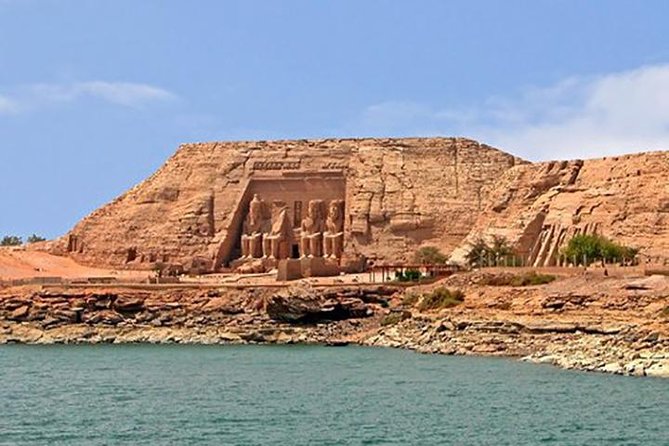
Abu Simbel is far from Aswan, but the distance gives the visit its sense of occasion. You leave the Nile Valley and cross a broad stretch of desert toward the western edge of Lake Nasser. There are no long strings of temples along the route, just a sustained ride toward one dramatic destination.
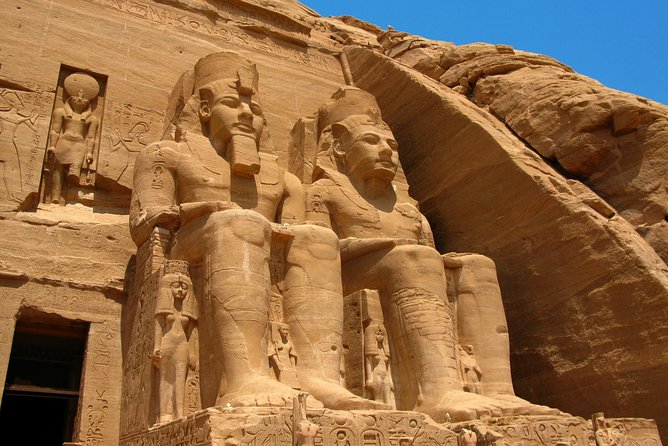
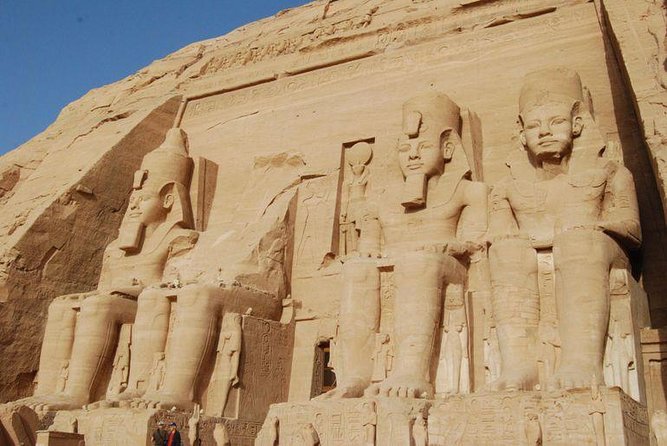
At the end of that road, four huge seated figures of Ramses II face the approach to the Great Temple. They are not delicate ruins. They are enormous, deliberate, and slightly overwhelming in the best possible way. The smaller Temple of Hathor sits beside it, with figures of Ramses and his wife Nefertari carved into its facade.
I would not treat this as a quick add-on between two other major activities. The drive alone takes around six hours round trip. Still, if you are based in Aswan, Abu Simbel is one of the most important ancient sites you can reach without flying, and the temples repay the effort.
The site was built in the 13th century BC during the reign of Ramses II. It was later discovered by accident in 1813, after centuries of being partly buried. Its modern survival is another remarkable chapter: the temples were dismantled and reconstructed on higher ground in 1968, ahead of the flooding caused by the Aswan High Dam.
More ways to reach Abu Simbel:
- 4-Days Nile Cruise From Aswan To Luxor including Abu Simbel and Hot Air Balloon
★ 5.0 · 3,142 reviews - From Aswan: Abu Simbel Temple Day Trip with Hotel Pickup
★ 4.4 · 2,807 reviews - 4-Day 3-Night Nile Cruise from Aswan to Luxor&Abu Simbel+Balloon
★ 5.0 · 2,023 reviews
A private minibus makes the long road easier
Pickup is offered from Aswan hotels and the port, which is useful if you are staying aboard a Nile cruise boat or have only a short stay in town. One group was met at the train station, while another was greeted at its boat before the trip. That kind of local coordination matters in Aswan, where your departure point may not be a standard hotel lobby.
Transport is by private, air-conditioned minivan. That gives you more privacy than a large coach and avoids collecting unrelated groups at several hotels. Some groups were only two people, which made the ride feel almost like a private car trip rather than a formal excursion.
The vehicle quality can vary. Several people appreciated a comfortable minibus and an onboard ice box, especially in hot weather. One person found the small van less spacious than expected, particularly during a very early departure. You should think of this as practical transport for a long desert crossing, not a luxury touring vehicle.
The road is commonly traveled in a convoy. This is tied to tourist police and road-safety procedures, so the departure and return can be controlled by officials rather than by your guide. A convoy can make the trip feel organized, but it can also create delays, confusing turns, or a late arrival.
That timing issue is important. A late start may sound attractive, especially if you want extra sleep, but the return schedule can leave you with little time at the temples. One group had only about an hour and fifteen minutes on site after convoy problems. Ask clearly about the likely departure and return convoy before you settle on a time.
Choosing between a 4 a.m. start and a later departure
The early start is the traditional choice. Leaving around 3:45 or 4 a.m. can help you arrive before the busiest period and may give you a better chance of seeing the facades with fewer people around. The road is also cooler before the day heats up.
The tradeoff is obvious: you lose much of your night. A boat may provide a box breakfast with coffee or tea, but this is still a long day. Bring water, and if your hotel allows it, a small travel pillow can make the minibus ride more comfortable.
Some people were pleased with a later departure around 8:45 a.m., particularly when they had no afternoon plans in Aswan. Others left close to midnight and reached Abu Simbel with very few people around, then watched the light change during the return drive. These options can work, but they depend on convoy rules and the day’s traffic pattern.
I would choose the earliest practical departure if avoiding crowds is your top priority. I would choose a later time only if sleep matters more and you accept the possibility of a shorter visit. Do not assume the departure time is fully flexible just because you can select a preferred time when booking. Confirm it with the local operator.
Facing the Great Temple of Ramses II
The approach to the Great Temple is the emotional high point of the trip. The facade is dominated by four seated colossi of Ramses II, carved directly into the cliff. Their scale is hard to grasp in photographs, especially when you walk close enough to see visitors standing at their feet.
Your guide should explain the main story before you enter. Guides cannot accompany you inside either temple because of visitor-control rules, so the outside briefing is your main source of interpretation. A good guide will use photographs or illustrations to point out the layout, statues, scenes, and religious meaning before you explore alone.
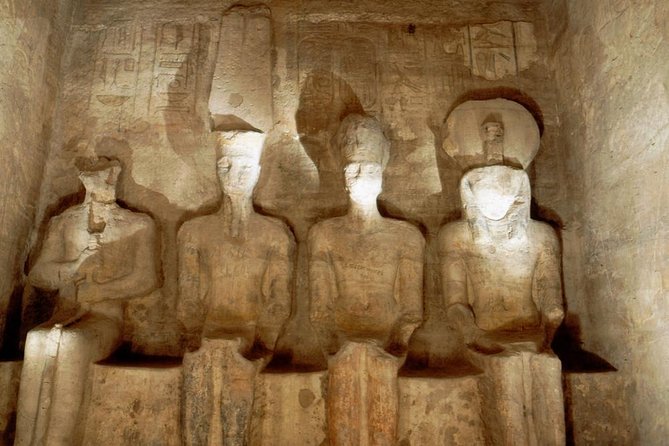
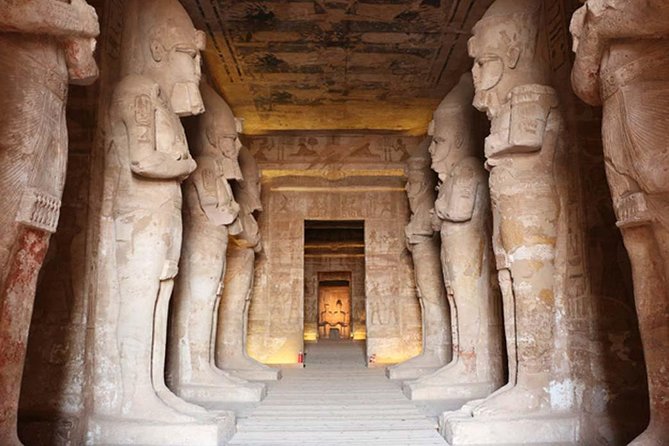
Inside the Great Temple, you pass through halls lined with colossal figures of Ramses. Painted battle scenes cover the walls, including images linked to the king’s military campaigns. The interior is not simply a dark continuation of the facade. It has its own sequence of spaces, with the scale changing as you move inward.
Take a moment to look up and around rather than walking straight toward the innermost room. The painted surfaces and carved figures can be easy to miss when other people are moving through the same halls. Since your guide will not be beside you inside, remember the points from the outdoor talk and take your time.
The free period is valuable, but it may not be generous. If your arrival is delayed, ask how much time you have before returning to the minibus. You want enough time for both temples, not twenty minutes of rushed photographs at the Great Temple followed by a glance at Hathor.
More things to do in Aswan:
- 4-Day 3-Night Nile Cruise from Aswan to Luxor including Abu Simbel, Air Balloon
★ 4.5 · 612 reviews - From Aswan: 3-Day Cruise to Luxor with Hot Air Balloon
★ 4.3 · 598 reviews - From Aswan: 4-Day Nile Cruise from Aswan to Luxor with Guide
★ 4.1 · 593 reviews - 4-Days Nile Cruise From Aswan To Luxor including Abu Simbel and Hot Air Balloon
★ 4.5 · 509 reviews
The smaller Temple of Hathor and Nefertari
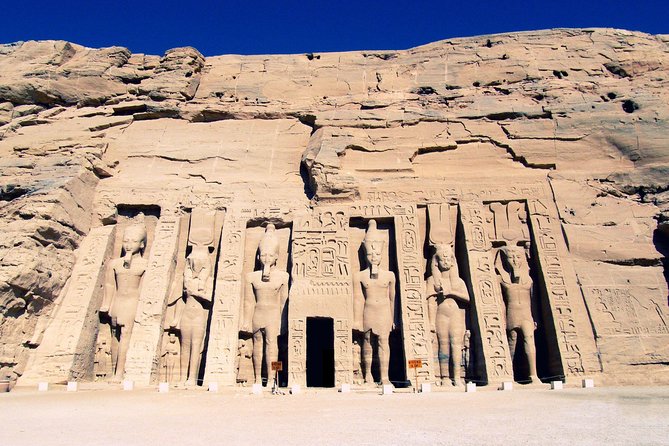
The Temple of Hathor is smaller, but do not treat it as a footnote. Its facade has six standing figures, including Ramses II and Nefertari. It was dedicated to the goddess Hathor and celebrates Nefertari, Ramses’ favored wife, in a way that gives the second temple its own identity.
Inside, look for the murals and pillars showing Hathor and Nefertari. The scale is more intimate than at the Great Temple, and that contrast makes the two-site visit work well. The first temple presents royal power on a huge scale. The second gives more attention to divine and royal partnership.
Because the guide cannot enter, the value of your outdoor explanation depends on how clearly the details are presented. Several guides received strong praise for their English and site knowledge. Michael was described as fluent and well prepared, while Mark was praised for his Egyptology background and friendly manner. Other people found their guide’s briefing too basic or felt the guide spent too much time on a phone.
That unevenness is the largest quality risk in this tour. The product is private, but a private group does not automatically guarantee a strong guide. If you have particular interests, such as the relocation work, temple symbolism, or the battle scenes, tell your guide early and ask for a proper explanation before you enter.
The 1968 relocation is almost as impressive as the temples
The temples you see are ancient, but they are not in their original position. The Aswan High Dam created Lake Nasser, which threatened to submerge Abu Simbel. An international UNESCO project cut the temples into sections and rebuilt them higher up, preserving the cliff facade and interiors.
It is difficult to spot the joins when you look at the finished monument. That is part of the achievement. The entire cliff face appears ancient and continuous, even though the modern structure was taken apart and reassembled piece by piece.
If time permits, stop at the nearby visitor center after the temples. It documents the relocation project and helps explain why the site looks as it does today. Do not count on a long visit there, since the convoy and return schedule may leave little spare time.
I would gladly trade an unwanted shopping stop for the visitor center. One group was asked about a papyrus shop and chose not to stop. Another found that the extra stop was not pressed. If you prefer archaeology to shopping, say so politely and clearly at the start.
How much time will you really have?
The advertised temple stop is about two hours, but the full day lasts around eight hours. That sounds generous until you subtract the drive. In practice, your time at Abu Simbel depends on road conditions, convoy organization, arrival time, and the agreed departure back to Aswan.
Several people felt the temple visit was rushed, with only about an hour available. Others considered the time adequate, especially when the guide gave a useful briefing and helped with photos outside. This variation means you should not plan another important activity immediately after your estimated return.
The site itself is compact enough to see in a limited window, but you still want time for both interiors and the facades. If you have a choice, prioritize the Great Temple first, then the Temple of Hathor, then the visitor center. Take your photographs early, but keep some time for simply looking at the carved figures.
The desert ride is part of the cost in time and energy. You may see camels along the road, and the change from the river region to open desert gives you a sense of how remote Abu Simbel is. Still, bring water and prepare for long stretches without sightseeing.
Is the $231.42 price fair?
At $231.42 per person, this is a costly day trip, particularly for a solo visitor. The price makes more sense for a small group that values private transport, hotel or port pickup, and an Egyptologist guide without strangers in the vehicle.
The value is strongest when your schedule is tight. If you have only one day in Aswan, arranging transport, a driver, a guide, and the convoy yourself may be more trouble than the difference in price. The local operator has to coordinate these moving parts, and several people appreciated being met at their boat or station and having the next morning’s arrangements confirmed in person.
The value is weaker if you are traveling alone and can easily arrange a similar private car through your hotel. One person specifically felt the same money could buy a comparable trip locally, while another found the private setup comfortable and worthwhile. You should compare the total cost, not just the headline price: ask if temple admission is included, confirm the vehicle type, and check how much time is planned at the site.
The guide also affects the price. A strong guide who explains the temples before you enter can turn a spectacular but confusing monument into a readable one. A weak guide can leave you with a ten-minute talk and six hours of driving. That is why it is worth confirming the guide’s language and asking for a clear site briefing.
Who will enjoy this Abu Simbel trip most?
I would recommend it to couples, families, and small groups who want privacy and direct pickup. It also suits anyone arriving by Nile cruise, since pickup and drop-off at the Aswan port are offered.
You should be comfortable with a long road day. The drive is roughly three hours each way, the departure may be very early, and the heat can be intense. One person described standing outside in temperatures around 107 degrees Fahrenheit while receiving the site explanation, so listen from a shaded spot when possible and carry water.
This is less suitable if you dislike rigid convoy schedules or need a relaxed, unhurried visit. It may also disappoint if you expect your guide to walk through the temple interiors with you. That is not permitted, so the tour depends on a good explanation before you go inside.
Guides and drivers have produced mixed results. Mark, Michael, and drivers such as Peter received warm praise for professionalism, language skills, and punctuality. Other accounts describe a guide who could not answer basic questions, a driver whose manner felt unsafe, or a return trip made uncomfortable by poor use of headlights. Those reports do not define every departure, but they are reasons to confirm details and speak up if something feels wrong.
Should you book it?
Book this tour if seeing Abu Simbel is a priority, you are based in Aswan, and you value private transport more than the lowest possible price. The temples are extraordinary, and the combination of Ramses’ giant statues, Nefertari’s temple, Lake Nasser, and the relocation story makes the long journey worthwhile.
I would book with two requests in writing: the earliest practical convoy that still gives you enough sleep, and a clear minimum amount of time at the temples. I would also ask for a guide who can explain the interiors before you enter, since that is where the tour’s educational value rises or falls.
Skip this option if your budget is tight, your group can arrange a cheaper local car, or you cannot spare most of a day. Abu Simbel itself deserves the visit. The decision is whether the privacy, coordination, and guide are worth paying for in this particular format.
FAQ
How long does the Abu Simbel tour take?
The experience lasts approximately eight hours, including the drive from Aswan, the temple visit, and the return journey.
How long is the drive from Aswan to Abu Simbel?
The drive takes approximately three hours each way, for about six hours of total road time.
Which temples are included?
You visit the Great Temple of Ramses II and the smaller Temple of Hathor, also associated with Nefertari.
Is transportation included?
Yes. Private transportation by air-conditioned minivan is included, with pickup from an Aswan hotel or port and drop-off afterward.
Is the tour private?
Yes. Only your group participates in the activity.
Can I choose the departure time?
You can choose a preferred departure time when booking, but convoy and tourist police arrangements may affect the final timing.
Can the guide enter the temples with me?
No. Guides are not permitted inside either temple because of the high number of visitors. The guide explains the interiors before you enter, using photographs and illustrations.
Is the visitor center included?
A short visit to the nearby visitor center may be possible if time permits. It explains how the temples were relocated in 1968.
What is the cancellation policy?
You can cancel at least 24 hours before the experience start time for a full refund. Cancellations or changes made less than 24 hours in advance are not accepted for a refund.
Just added around Aswan
- Private Day Tour to Abu Simble Temple from Aswan★ 4.5 · 23 reviews
- Nile Cruise 2 Nights from Aswan to Luxor with Hot air Balloon★ 4.5 · 23 reviews
- Private Aswan Airport Arrival/Departure One Way Transfer★ 4.5 · 23 reviews
- Best of Luxor in 2 Days Hotel,Tours,Felucca,Camel&Balloon by Plane from Cairo★ 5.0 · 23 reviews
- (3-Nights Cruise From Aswan To Luxor & Balloon, Abu Simbel)★ 4.5 · 23 reviews
- Full Day Sharing Trip To Abou simple Temple form Aswan★ 5.0 · 24 reviews
- Enjoy 2 nights Nile cruise from Aswan to Luxor,Hot deal★ 4.5 · 24 reviews
- 3-Day 2-Night Tour to Aswan, Abusimbel & Luxor★ 5.0 · 24 reviews
Abu Simbel Tours, compared.

4-Days Nile Cruise From Aswan To Luxor including Abu Simbel and Hot Air Balloon
Read our review →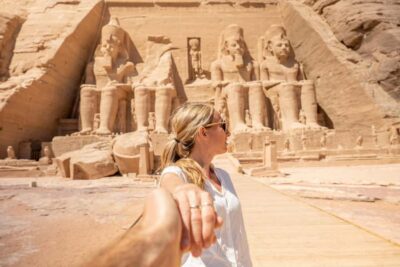
4-Day 3-Night Nile Cruise from Aswan to Luxor including Abu Simbel, Air Balloon
Read our review →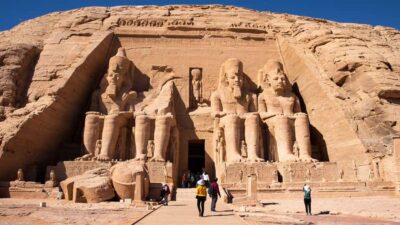
Abu Simbel Temple Private Guided Day Trip with Lunch
Read our review →4-Days Nile Cruise From Aswan To Luxor including Abu Simbel and Hot Air Balloon
Read our review →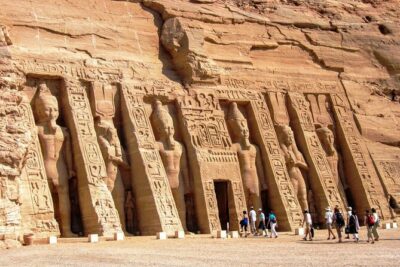
Private Day Tour to Abu Simbel Temples from Aswan
Read our review →4 Days Nile Cruise from Aswan to Luxor including Abu Simbel and Hot Air Balloon
Read our review →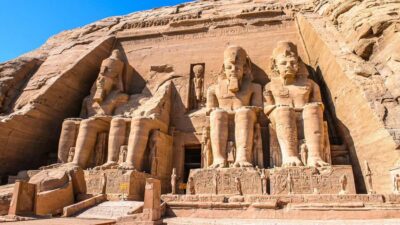
Browse the lists this tour appears in