
Reviewed · KARNAK & LUXOR TEMPLE TOURS
Private Tour: Luxor East Bank, Karnak and Luxor Temples
History gets very large in Luxor. This private tour makes it manageable, pairing Karnak’s giant Hypostyle Hall with the more compact, atmospheric Luxor Temple. I like the one-to-one format and the included hotel or river-port pickup, though three and a half hours can feel short at Karnak.
I also like the chance to set your own pace with an Egyptologist guide. Guides such as Adel, Bassem, Michael, Hisam, Yolanda, and Abdul have been praised for clear explanations, warm personalities, and extra time for photographs. The main point to consider is the afternoon start at 1:00 p.m., which may bring strong heat and bright sun.
In This Review
- Key Points Before You Book
- Why Karnak Should Come First
- The 134 Columns of the Hypostyle Hall
- The Sacred Lake and the End of the Karnak Visit
- Luxor Temple Has a More Focused Story
- What the Egyptologist Guide Adds
- Private Transport and the Afternoon Schedule
- Is $107.88 Per Person Good Value?
- Who Will Enjoy This Tour Most?
- Small Details That Make the Visit Better
- Should You Book the Karnak and Luxor Temple Tour?
- FAQ
- How long does the private Luxor temple tour last?
- What time does the tour start?
- Which temples are included?
- Is hotel pickup included?
- Is transportation provided?
- Is an Egyptologist guide included?
- Are admission tickets included?
- Is food included?
- Can I cancel the tour for a refund?
Key Points Before You Book
- Karnak is the main event: Its 134-column Hypostyle Hall, massive pylons, sacred lake, and long Avenue of Sphinxes make it one of Luxor’s essential sights.
- Luxor Temple adds a different mood: It is smaller and easier to follow, with Ramses II statues, papyrus columns, carved walls, and Alexander the Great’s chapel.
- Private guiding makes a real difference: You can ask questions, pause for photographs, and spend more time on the details that catch your eye.
- Pickup is included: The tour begins from a central Luxor hotel or the Luxor river port in an air-conditioned minivan.
- The price is reasonable for a private half-day: At $107.88 per person, value improves with two or more people sharing the experience.
- Check the language fee: English guiding is included, while languages other than English carry a 1,000 Egyptian pound supplement.
Why Karnak Should Come First
Karnak is not a single temple in the usual sense. It is a huge religious complex that grew over roughly 2,000 years, with more than 30 pharaohs adding gateways, courts, halls, chapels, statues, and sanctuaries.
That long building program is what makes the site so rewarding. You can literally see different rulers trying to leave their mark. Amenhotep IV and Ramses II are among the pharaohs connected with the complex, and each generation altered the space around it.
Your guide begins along the Avenue of the Sphinxes, where the approach gives you a sense of Karnak’s former scale. The avenue once connected Karnak with Luxor Temple over a distance of about two kilometers. Only part of it marks the entrance today, but even this surviving section helps explain how the two temples once worked together.
The entrance pylons are enormous. Rather than simply pointing out their size, a good guide can explain their role as gateways between the ordinary world and sacred space. Look closely at the carved surfaces, where the walls carry scenes and symbols linked to royal power and Egyptian religion.
From there, you move into broad courtyards and increasingly older sections of the complex. The tour description notes that the farther you go inside, the farther back in time you travel. That is a useful way to understand Karnak. It is not just a collection of impressive ruins. It is a layered record of Egypt’s changing rulers and religious life.
More Karnak and Luxor Temple visits:
- Hurghada: Luxor Tour with Valley of Kings, Karnak & Tut Tomb
★ 4.6 · 1,082 reviews - Luxor: Valley of Kings, Hatchepsut Temple ,Karnak & Luxor-DayTour
★ 5.0 · 735 reviews - Luxor: Karnak Temple and Luxor Temple Tour with Lunch
★ 4.4 · 658 reviews
The 134 Columns of the Hypostyle Hall
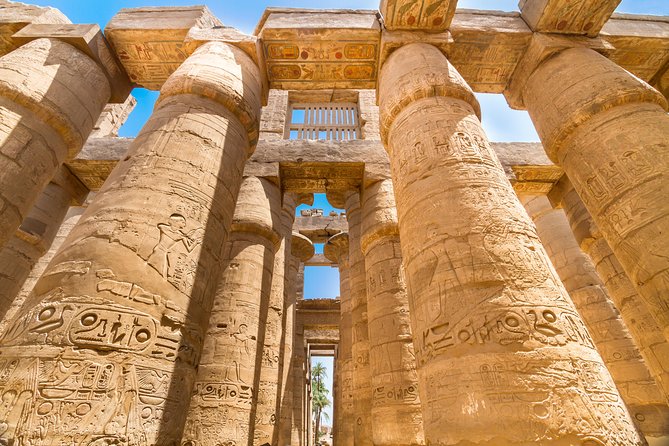
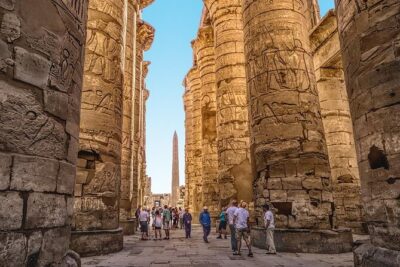
The Great Hypostyle Hall is Karnak’s visual knockout. Its 134 columns rise above you in dense rows, creating the feeling of an ancient stone forest.
This is where a private guide earns the cost of the tour. Without help, you may see a mass of columns and carved walls. With an Egyptologist explaining how the hall was used, how the columns were decorated, and how the Egyptians raised such huge structures, the scene becomes easier to understand.
Give yourself time to look up. The scale is hard to grasp from photographs, and the lower sections of the columns carry detailed carvings that deserve a slower look. You may also notice differences in the condition and color of the reliefs. Your guide can help you separate the original features from later changes and explain the figures and symbols.
Karnak can be tiring. The complex is large, and the ground underfoot is uneven in places. The planned visit allows about an hour at the site, followed by some free time to walk around. That is enough for the main sights, but it will not cover every corner.
If you love archaeology, ask your guide to focus on the details that interest you most. If you prefer the broad story, stay with the main route through the pylons, courts, Hypostyle Hall, and sacred lake. The private setup lets you make that choice.
The Sacred Lake and the End of the Karnak Visit
The sacred lake gives you a quieter pause after the huge hall. It was connected with temple rituals, including the purification of offerings used in worship.
The lake also helps you understand that Karnak was a working religious center, not simply a royal monument. The site had practical spaces tied to ceremonies, priests, offerings, and daily temple life.
You receive free time to look around before leaving for Luxor Temple. Use it for photos, a final look at the columns, or a short pause away from the busiest parts of the complex. The afternoon schedule can help here, since the light may change as the visit continues, but the tradeoff is exposure to the heat.
The drive between the two temples is short by modern standards. Your air-conditioned minivan provides a welcome break, especially after walking across Karnak.
Luxor Temple Has a More Focused Story
Luxor Temple is smaller than Karnak, but I find its layout easier to take in. It lies in central Luxor, parallel to the Nile, and its buildings were added to over time by rulers including Ramses II, Tutankhamun, and Alexander the Great.
The entrance is dominated by two colossal statues of Ramses II. These figures immediately establish the tone: royal power, military strength, and an ambition to make the pharaoh appear larger than life.
Nearby is the granite gateway obelisk. Luxor retains one of the original pair, while its companion was taken to Paris and now stands at the Place de la Concorde. This is one of those details that connects a visit to Luxor with a familiar landmark far beyond Egypt.
Inside, the temple becomes more intimate. You pass through courts, columns, and inner rooms decorated with hieroglyphs and carved scenes. Papyrus-shaped columns are among the most memorable details, and your guide can help explain how their forms relate to Egyptian religious ideas.
The temple also contains a chapel connected with Alexander the Great. Alexander rebuilt the room in his own name, adding another layer to a monument that had already been altered by several Egyptian rulers.
The planned visit lasts about an hour. That is enough to see the main entrance, statues, obelisk, courts, columns, and inner sanctuaries without rushing badly. Still, you should not expect the same amount of wandering time you might have on a full archaeological day.
More things to do in Luxor:
- Hurghada: Luxor Valley of the Kings & Tutankhamun Tomb Trip
★ 4.7 · 13,208 reviews - Luxor Day Trip from Hurghada Small Group & Tutankhamun Tomb
★ 4.8 · 5,366 reviews - Hot Air Balloon Ride in Luxor Egypt with Transfers Included
★ 5.0 · 4,319 reviews - Luxor: Shared Full-Day Tour to Luxor West and East Banks
★ 4.5 · 1,812 reviews
What the Egyptologist Guide Adds
You can visit both temples without a guide, but you would miss much of the meaning behind the carvings and layout. Egyptian temple art is full of symbols, royal titles, gods, rituals, and political messages. A guide gives those details a place in the larger story.
The strongest guide feedback centers on enthusiasm as much as facts. Adel is praised for bringing the past to life with humor, intelligence, and personal warmth. Bassem is noted for explaining the temples in detail, while Michael is praised for punctuality, friendliness, and allowing plenty of time for photographs.
Yolanda and her driver Tony are also singled out for an excellent combination of enthusiasm, courtesy, and skilled driving. Hisam is described as very smart and well informed. Abdul receives praise for answering questions and giving enough time to explore, although one account noted that he seemed tired and possibly unwell during part of the visit.
That last point is worth keeping in mind. Guide quality can vary from person to person, even when the overall service is strong. The rating is 4.8 from 63 reviews, with 95 percent recommending the experience, so the pattern is clearly positive. Still, you should approach a private tour as a conversation. Ask questions, tell your guide what interests you, and speak up if you need a slower pace.
Private Transport and the Afternoon Schedule
Pickup is offered from a central Luxor hotel or the Luxor river port. You travel between the sites in a private, air-conditioned minivan, then return to the original starting point.
That arrangement matters in Luxor. You avoid arranging separate taxis between two major sites, and you have a guide and driver responsible for keeping the visit moving. The private vehicle also gives your group a place to cool down between stops.
The listed meeting time is 1:00 p.m., and the full experience lasts about three and a half hours, sometimes described as a four-hour visit. The afternoon timing works well if you have spent the morning resting, arriving by river cruise, or visiting another part of Luxor.
The drawback is heat. Karnak involves a lot of open-air walking, and the tallest columns offer little shade. Bring water, a hat, sunscreen, and shoes suitable for walking. Food and drinks are not included, so plan accordingly.
The timing may also suit you if you want to see Luxor Temple after the glare of midday begins to soften. However, the exact light and temperature will depend on the season. The tour does not promise a sunset visit, so book it for the private guiding and efficient sightseeing rather than for a specific lighting effect.
Is $107.88 Per Person Good Value?
The listed price is $107.88 per person. For a private tour with an Egyptologist, hotel or port pickup, air-conditioned transport, and admission to both temples, that is a fair price, especially for couples, families, or small groups.
The value depends on how many people are in your party. Solo visitors pay more per person for private service, while two or more people can share the cost. Group discounts are offered, but the exact reduction is not specified, so check the final booking price before you commit.
Admission tickets are included, which makes the cost easier to judge. Food and drinks are not included, but this is a short half-day visit rather than an all-day excursion.
English guiding is included in the listed price. French and other languages may be available, but a 1,000 Egyptian pound supplement applies to all languages except English. Confirm the language and added cost at booking.
Who Will Enjoy This Tour Most?
I would choose this tour if you want the main East Bank sights with a guide focused only on your group. It suits first-time visitors who want context without spending a full day at one giant archaeological site.
It is also a good match for cruise passengers using the Luxor river port. The pickup and return arrangement cuts down on planning, and the private vehicle makes the schedule easier to manage.
Families may appreciate the ability to ask questions and pause for photographs without holding up a large group. Couples and small groups get a more personal experience, particularly at Karnak, where it is easy to feel lost among the courts and columns.
Independent archaeology fans should note the limits. An hour at Karnak plus free time is enough for highlights, not every chapel and side area. If you want a slow, specialist study of the complex, you may prefer a longer visit or a guide booked for a full day.
Small Details That Make the Visit Better
Read a little about the major pharaohs before you go. Even a basic understanding of Ramses II, Tutankhamun, Amenhotep IV, and Alexander the Great will help you follow the changes at both temples.
At Karnak, save energy for the Hypostyle Hall. The entrance pylons are impressive, but the columns are the part most people remember. At Luxor Temple, compare the scale and mood with Karnak. Luxor feels more compact and direct, while Karnak reveals itself in stages.
Ask for time to take photographs after the main explanations. Michael is praised for allowing extra photo time, and the private format generally makes such requests easier. Your guide may also point out architectural oddities and mistakes at Luxor Temple, details that add character to the visit.
Wear practical clothing for hot weather and bring water. Since the tour is conducted outdoors for much of the time, comfort matters more than dressing formally.
Free cancellation is available up to 24 hours before the 1:00 p.m. start time. Changes or cancellations made less than 24 hours in advance are not accepted for a refund.
Should You Book the Karnak and Luxor Temple Tour?
Book it if you want a reliable introduction to Luxor’s East Bank, value private attention, and prefer transport and tickets arranged together. The combination of Karnak’s huge scale and Luxor Temple’s concentrated beauty gives you two very different views of ancient Egyptian worship and royal power.
I would hesitate only if you want a long archaeological study, dislike afternoon heat, or are traveling alone and trying to keep costs as low as possible. For most couples, families, cruise passengers, and first-time visitors, the private guide is the key reason to choose it.
At $107.88 per person, the experience is not the cheapest way to see the temples. It is a sensible buy if your goal is to understand what you are seeing rather than simply walk past the columns, take photographs, and leave wondering which pharaoh built what.
FAQ
How long does the private Luxor temple tour last?
The experience lasts approximately three and a half hours, though it is also described as a four-hour tour.
What time does the tour start?
The listed start time is 1:00 p.m.
Which temples are included?
The tour visits the Temples of Karnak and Luxor Temple on Luxor’s East Bank.
Is hotel pickup included?
Yes. Pickup and drop-off are included from a central Luxor hotel or the Luxor river port.
Is transportation provided?
Yes. Private transportation is provided in an air-conditioned minivan.
Is an Egyptologist guide included?
Yes. A qualified Egyptologist guide is included in the price for English guiding.
Are admission tickets included?
Yes. Admission tickets are included for both Karnak and Luxor Temple.
Is food included?
No. Food and drinks are not included unless specifically stated.
Can I cancel the tour for a refund?
Yes. You can cancel at least 24 hours before the start time for a full refund. Cancellations or changes made less than 24 hours before the start time are not accepted for a refund.
Just added around Luxor
- Private Tour foll day to East and West Banks of Luxor★ 5.0 · 23 reviews
- East and West Bank Luxor★ 5.0 · 23 reviews
- Full Day Tour to Luxor (East & West Bank)★ 5.0 · 23 reviews
- Big brother travel★ 5.0 · 23 reviews
- Luxor Day Tour :Valley of Kings & queen & Hatshepsut & Habu city★ 5.0 · 23 reviews
- Luxor: Scenic Camel or Horse Ride★ 3.9 · 24 reviews
- From Cairo: 4-Day Nile Cruise from Aswan to Luxor with Meals★ 4.4 · 24 reviews
- Traditional Egyptian Breakfast at the AlHabib Arabian Horse Farm★ 5.0 · 24 reviews
Karnak & Luxor Temple Tours, compared.
Luxor Tour with Valley of Kings, Karnak & Tut Tomb
Read our review →
Valley of Kings, Hatchepsut Temple ,Karnak & Luxor-DayTour
Read our review →
Valley of Kings Hatshepsut & Karnak Luxor Day Trip
Read our review →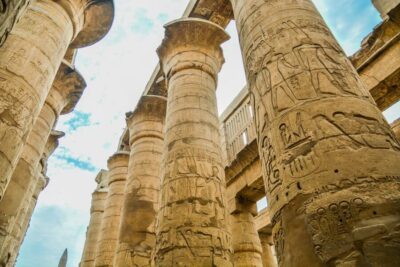
Valley of the Kings & Karnak Temples Luxor Tour
Read our review →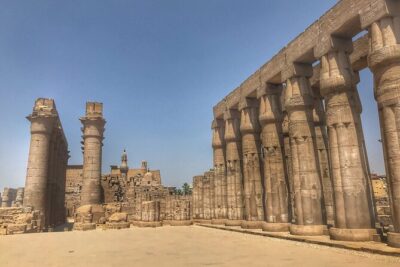
Private Half-Day Tour to Karnak & Luxor Temples From Luxor
Read our review →
Half Day East Bank Tour to Luxor and Karnak Temples (Private)
Read our review →Browse the lists this tour appears in