
Reviewed · ASWAN TOURS
Top Day Tour To Luxor From Aswan
Luxor packs centuries into one day. This private trip from Aswan gives you a practical way to see the Valley of the Kings, Hatshepsut’s temple, Karnak, and Luxor Temple without changing hotels or arranging several separate rides. I especially like the private air-conditioned vehicle and the qualified Egyptologist guide, since the sites make far more sense when someone explains the rulers, gods, and burial customs behind the stones.
I also like the care shown by guides such as Mohamed Hashimi, Ayman, Ahmed, Ashraf, and Ghada Khalaf, who have been praised for clear explanations, photos, humor, and flexibility with languages. The main drawback is the very long road day, along with unclear information about the pickup time and lunch. Confirm both before paying, because the stated 7:00 p.m. departure does not fit the advertised 10:00 a.m. arrival in Luxor.
In This Review
- Key points to know before booking
- Why this Aswan to Luxor day trip makes sense
- The long road through the Nile Valley
- Valley of the Kings: tombs built for eternity
- Hatshepsut’s temple and the story of a female ruler
- The Colossi of Memnon in a quick half-hour stop
- Karnak: Egypt’s monumental scale
- Luxor Temple and the idea of royal renewal
- Guides, drivers, and the human side of the day
- Lunch, shopping, and the small print that matters
- Who should book this tour?
- FAQ
- How long is the tour from Aswan to Luxor?
- Is hotel pickup and drop-off included?
- Is this a private tour?
- Which sites are visited?
- Is lunch included?
- Can I cancel for a full refund?
Key points to know before booking
- 280 kilometers by road: You spend roughly three hours each way between Aswan and Luxor, so the sightseeing day is long but efficient.
- Five major ancient sites: The route covers the Valley of the Kings, Hatshepsut’s temple, the Colossi of Memnon, Karnak, and Luxor Temple.
- Private sightseeing: Only your group participates, which gives you more freedom than a large coach tour.
- A guide makes the difference: Egyptologists such as Mohamed Hashimi, Ayman, Ahmed, Ashraf, and Ghada Khalaf have been praised for strong explanations and personal service.
- Lunch needs checking: The tour details describe lunch as included in one place and optional in another, so ask exactly what your $140 covers.
- Free cancellation: You can cancel for a full refund up to 24 hours before the scheduled start time.
Why this Aswan to Luxor day trip makes sense
Aswan and Luxor are about 280 kilometers apart by road. That distance matters. This is not a gentle half-day outing. With about 13 hours in total, you will spend a large part of the day in the vehicle, but you also reach the main monuments of ancient Thebes in one concentrated sweep.
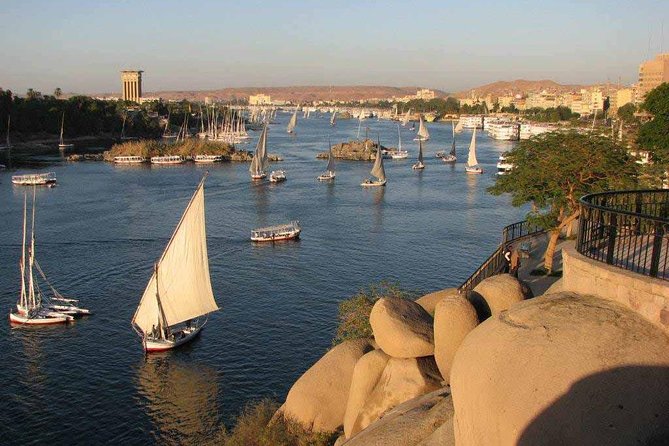
I like this arrangement for visitors with limited time in southern Egypt. You can keep your hotel or Nile cruise in Aswan and still see Luxor’s two main zones: the West Bank, with royal tombs and mortuary temples, and the East Bank, with the great temple complexes.
The private format adds real value. You are not simply being moved from one photo stop to the next with a large crowd. Your own guide and driver handle the day for your party, and the guide can spend more time on questions or adjust explanations to suit your interests.
The price is $140 per person. That is reasonable if the fee truly includes private transport, hotel pickup and return, entrance fees, bottled water, and an Egyptologist guide. It becomes less attractive if lunch is extra and you are traveling alone, since the cost is charged per person. Group discounts may help families or friends traveling together.
One practical warning comes first. The timing says pickup at 7:00 p.m., arrival in Luxor at 10:00 a.m., and a 13-hour tour. Those details do not agree. A morning departure would make sense for a daytime visit, but you should confirm the exact pickup hour directly with Emo Tours Egypt before the trip.
More things to do in Aswan:
- 4-Days Nile Cruise From Aswan To Luxor including Abu Simbel and Hot Air Balloon
★ 5.0 · 3,142 reviews - From Aswan: Abu Simbel Temple Day Trip with Hotel Pickup
★ 4.4 · 2,807 reviews - 4-Day 3-Night Nile Cruise from Aswan to Luxor&Abu Simbel+Balloon
★ 5.0 · 2,023 reviews
The long road through the Nile Valley
The drive north from Aswan takes you through the Nile Valley, with traditional villages and cultivated land visible along the way. This is one of the quieter pleasures of the trip. You are not flying over Egypt or staying inside a resort bubble. You see the narrow strip of life that depends on the river, then watch it give way to the dry country around Luxor.
Your hotel or Nile cruise pickup is included, as is the return at the end of the day. The vehicle is described as private and air-conditioned, which is important in southern Egypt. A three-hour ride each way can feel punishing in a poor vehicle, so this is one of the features I would value most.
The journey still requires stamina. Bring water, use the included bottled water sensibly, and keep the pace in mind. If you want long, unhurried visits inside every tomb and temple, a two-day Luxor stay will suit you better. If you want the major sights in one day, this route gets the job done.
Valley of the Kings: tombs built for eternity
The West Bank begins with the Valley of the Kings, one of Luxor’s essential stops. Here, pharaohs were buried in rock-cut tombs rather than in the exposed pyramids associated with earlier royal burials.
The tour includes the basic entrance area. Your admission normally covers a set number of tombs, while special tombs can require a separate ticket. The supplied information specifically notes that the entry fee covers the basic area, so ask your guide which tombs are included and whether any premium tomb, such as Tutankhamun’s, costs extra.
Inside, the focus shifts from grand exterior architecture to painted walls and narrow passages. You may see tombs linked with Thutmose I, Thutmose III, Tutankhamun, Ramesses VI, Merneptah, and Amenhotep II, depending on which chambers are open and included that day.
I find the Valley most rewarding when your guide explains what the scenes mean. The painted figures are not just decoration. They relate to the pharaoh’s passage into the next world, protective gods, ritual texts, and the king’s place in the cosmic order.
The drawback is simple: the valley can be hot, exposed, and tiring. The visit lasts about two hours, but that does not mean two hours inside tombs. You will move between sites, wait for access, and walk over uneven ground. Sensible shoes and modest clothing are useful.
Hatshepsut’s temple and the story of a female ruler
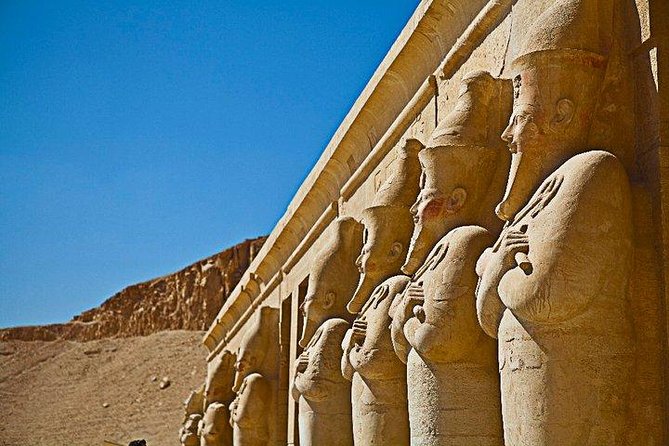
The Temple of Hatshepsut at Deir el-Bahari has a completely different feel. It is built in broad levels against the cliffs, with long terraces and strong horizontal lines. The setting makes the monument memorable before your guide says a word.
Hatshepsut ruled during Egypt’s 18th Dynasty and is remembered as the only pharaonic woman to reign as king in her own right. Her story is especially interesting because ancient Egyptian kingship was presented through male symbols and titles, even when the ruler was a woman.
This is where a strong guide adds value. Ask how Hatshepsut presented herself, how her reign related to Thutmose III, and what happened to her memory after her death. The point is not to reduce her story to a simple tale of revenge. The monument and surviving inscriptions offer a more complicated picture of royal power.
The temple visit is paired with the Colossi of Memnon. Together, the two stops show different sides of the Theban necropolis: one monument remains impressive through its design and setting, while the other survives mainly through two enormous statues.
A completely different sort of day out in Aswan:
- 4-Day 3-Night Nile Cruise from Aswan to Luxor including Abu Simbel, Air Balloon
★ 4.5 · 612 reviews - From Aswan: 3-Day Cruise to Luxor with Hot Air Balloon
★ 4.3 · 598 reviews - From Aswan: 4-Day Nile Cruise from Aswan to Luxor with Guide
★ 4.1 · 593 reviews - 4-Days Nile Cruise From Aswan To Luxor including Abu Simbel and Hot Air Balloon
★ 4.5 · 509 reviews
The Colossi of Memnon in a quick half-hour stop
The Colossi of Memnon are two huge stone figures of Amenhotep III. They once guarded the entrance to his mortuary temple, which was the largest temple in the Theban necropolis before time, flooding, and reuse reduced it to ruins.
The stop lasts about 30 minutes. That is enough to see the statues, take photographs, and hear the story behind their famous name. They were not actually images of Memnon, the figure from Greek mythology. Ancient Greek and Roman visitors associated the northern statue with that story, and inscriptions in Greek and Latin were added between about AD 20 and 250.
I like this stop because it reminds you that Egypt’s monuments had a long afterlife. They were not frozen in the moment of pharaonic construction. Later visitors interpreted them, wrote on them, and attached new stories to them.
Still, do not expect a long exploration here. The statues are the main event, and the visit is brief. Treat it as a focused photo and explanation stop rather than a full archaeological visit.
Karnak: Egypt’s monumental scale
After lunch, the route moves to Luxor’s East Bank and the Karnak Temple Complex. This is the largest and most expansive stop of the day, with about an hour scheduled for exploration.
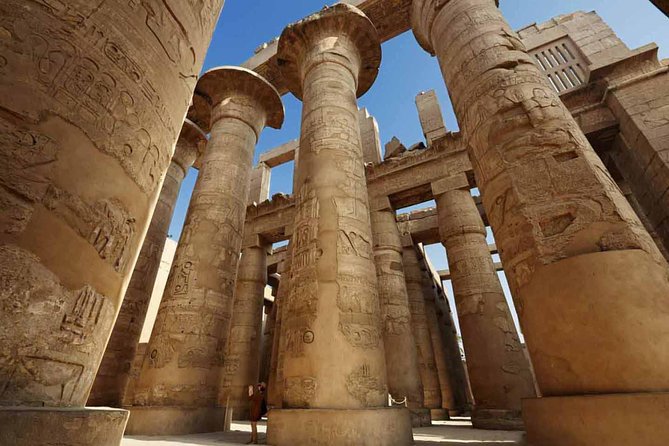
Karnak is not one building. It is a vast collection of temples, pylons, chapels, courts, and later additions built over many centuries. Construction began in the Middle Kingdom under Senusret I and continued through the Ptolemaic period, although much of what you see today comes from the New Kingdom.
The complex was known in ancient Egyptian as Ipet-isut, often translated as the Most Selected of Places. It served as the main center of worship for the Theban Triad, led by Amun. This religious role helps explain its scale. Pharaohs did not simply build a palace for themselves. They added to a sacred center that grew across generations.
Your guide should help you read the site in sections. Look for the monumental pylons, columns, chapels, processional spaces, and carved scenes of kings presenting offerings to the gods. Without context, Karnak can feel like a forest of stone. With a clear explanation, the separate parts begin to make sense.
One hour is useful but tight. You will see the main areas, yet you may wish for more time to linger over individual reliefs. If Karnak is the site you most want to study, tell your guide early. The private format may allow some adjustment, although the full day and return drive place limits on flexibility.
Karnak forms part of ancient Thebes, which was added to the UNESCO World Heritage List in 1979. That designation matters less than what you feel on the ground: this was a working religious center on a scale that is difficult to grasp from photographs.
Luxor Temple and the idea of royal renewal
Luxor Temple is the final major monument. Located on the East Bank, it was built around 1400 BCE and served a different purpose from Karnak.
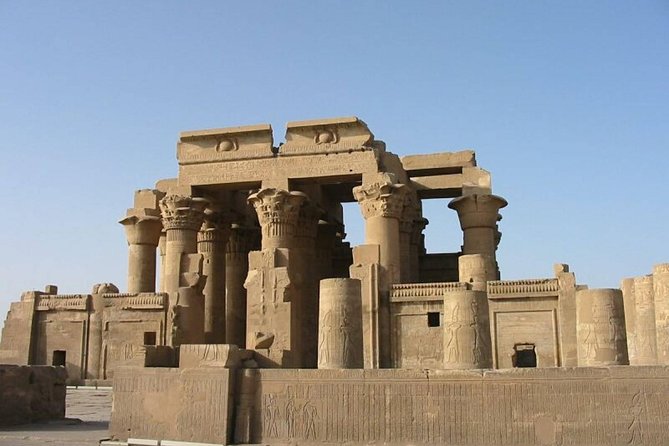
Its ancient name, Ipet Resyt, means the southern sanctuary. Rather than being devoted mainly to one cult god or a dead king, the temple focused on the renewal of kingship. It was a place where the authority of the ruler could be confirmed through ritual and divine association.
That idea gives the temple a special character. You are not only looking at columns and carved walls. You are seeing a carefully planned statement about order, legitimacy, and the connection between the pharaoh and the gods.
The temple also has links to later eras. Alexander the Great claimed to have been crowned at Luxor, though he may never have traveled south of Memphis. Your guide can help separate the political claim from what historians can firmly establish.
The visit is listed at about one hour. After the open spaces of Karnak, Luxor Temple feels more compact and direct. The reliefs, columns, and processional layout are easier to take in during a shorter visit, though you may be tired by this point.
Guides, drivers, and the human side of the day
The strongest part of this experience is likely to be the people assigned to your group. Mohamed Hashimi has been praised for handling the day carefully and helping with family photographs. Ayman has been noted for detailed explanations at the major monuments, while Ahmed, Ashraf, and Ghada Khalaf have also received strong praise for service and historical interpretation.
Ghada’s ability to remain helpful in difficult heat and during Ramadan was especially appreciated. That does not mean you should expect every guide to have the same style, but it does show why the guide selection matters.
Drivers also play an important role on this route. Chico was praised for being on time and collecting a visitor from a hotel, while another account noted that Mohammed was courteous and punctual even though his English was not fluent. The practical lesson is to judge the guide and driver separately. A driver may communicate only basic English while still doing the road portion well.
Ask questions, especially at the Valley of the Kings and Karnak. A private tour works best when you use the guide rather than simply following from one landmark to another.
Lunch, shopping, and the small print that matters
Lunch is the one major detail you should clarify. The highlights describe an included lunch, but the inclusions also say lunch at a local restaurant is optional. Ask whether the $140 price includes the meal, whether drinks are separate, and where the restaurant is located.
There is also a warning about a boutique stop. One account described this as predictable and aimed at tourists, though the overall experience still offered good value. You may prefer to spend every available minute at the monuments, so ask if shopping is planned and if it can be skipped.
Entrance fees cover the basic areas at the named sites. Special tombs or optional activities may cost more. Tipping is not included, and any extra tours are also outside the stated price.
Who should book this tour?
I would choose this trip if you are based in Aswan, have only one free day, and want the main Luxor sights with a private guide. Families may appreciate the included pickup, private vehicle, photo help, and the ability to ask for explanations at their own pace.
It also suits visitors who prefer historical context rather than simply taking pictures. Karnak and the Valley of the Kings can be confusing without a guide, and the Egyptologist-led format gives the monuments a clear story.
I would hesitate if you dislike long road journeys, need a slow pace, or want extended time at each tomb and temple. In that case, staying in Luxor for at least one night would be more comfortable.
Before booking, confirm three things: the real pickup time, the exact lunch arrangement, and which tomb entrance fees are included. If those points are clear, the $140 price offers a practical way to connect Aswan with the great monuments of ancient Thebes. The high 4.8 rating and 97 percent recommendation fit the tour’s main strengths: capable guides, reliable pickup in many cases, and a lot of history packed into one demanding day.
FAQ
How long is the tour from Aswan to Luxor?
The experience lasts about 13 hours in total. The road distance is approximately 280 kilometers each way, with the sightseeing taking place in Luxor.
Is hotel pickup and drop-off included?
Yes. Pickup is offered from your hotel or Nile cruise in Aswan, and transport back to your hotel is included after the tour.
Is this a private tour?
Yes. Only your group participates in the private activity.
Which sites are visited?
The route includes the Valley of the Kings, the Temple of Hatshepsut at Deir el-Bahari, the Colossi of Memnon, Karnak Temple, and Luxor Temple.
Is lunch included?
The information is inconsistent. One part describes lunch as included, while another lists lunch at a local restaurant as optional. Confirm this before booking.
Can I cancel for a full refund?
Yes. You can cancel at least 24 hours before the experience start time for a full refund. Changes or cancellations made less than 24 hours before the start time are not accepted for a refund.
Just added around Aswan
- Private Day Tour to Abu Simble Temple from Aswan★ 4.5 · 23 reviews
- Nile Cruise 2 Nights from Aswan to Luxor with Hot air Balloon★ 4.5 · 23 reviews
- Private Aswan Airport Arrival/Departure One Way Transfer★ 4.5 · 23 reviews
- Best of Luxor in 2 Days Hotel,Tours,Felucca,Camel&Balloon by Plane from Cairo★ 5.0 · 23 reviews
- (3-Nights Cruise From Aswan To Luxor & Balloon, Abu Simbel)★ 4.5 · 23 reviews
- Full Day Sharing Trip To Abou simple Temple form Aswan★ 5.0 · 24 reviews
- Enjoy 2 nights Nile cruise from Aswan to Luxor,Hot deal★ 4.5 · 24 reviews
- 3-Day 2-Night Tour to Aswan, Abusimbel & Luxor★ 5.0 · 24 reviews
Aswan Tours, compared.

4-Days Nile Cruise From Aswan To Luxor including Abu Simbel and Hot Air Balloon
Read our review →
4-Day 3-Night Nile Cruise from Aswan to Luxor including Abu Simbel, Air Balloon
Read our review →

4-Day Nile Cruise from Aswan to Luxor with Guide
Read our review →4-Days Nile Cruise From Aswan To Luxor including Abu Simbel and Hot Air Balloon
Read our review →
Private Day Tour to Abu Simbel Temples from Aswan
Read our review →
High Dam, Unfinished Obelisk, & Philae Private Tour
Read our review →Browse the lists this tour appears in