
Reviewed · LUXOR TOURS
Tour to The East & West Bank of the Nile
Ancient Egypt fills one long day. This private Luxor tour links the Valley of the Kings and Hatshepsut’s temple with Karnak and Luxor Temple, giving you the essential sights on both sides of the Nile without the usual group-tour shuffle. I like the door-to-door transport and the fact that entrance fees, bottled water, and lunch are already included. The main drawback is pace: eight hours is enough for the highlights, but not for a slow, detailed look at every monument.
I also like that your own English-speaking Egyptologist can adjust the explanations to your group. Guides such as Hany Refaat, Hany Taha, Hamy, Mansour, Marwa Ali, and El-Tayeb have been praised for clear explanations, patience, humor, and giving people time for photographs. Still, Luxor is hot, the sites are large, and this is a full sightseeing day with plenty of walking.
In This Review
- Key points at a glance
- Why this Luxor day works well
- Starting beneath the cliffs at the Valley of the Kings
- Hatshepsut’s temple and the story of a female ruler
- A short stop at the Colossi of Memnon
- Karnak, where scale becomes the lesson
- Luxor Temple beside the modern city
- Lunch, water, and the practical rhythm of the day
- The guide can make or break the experience
- Who should book this tour?
- Is the $169 price fair?
- Should you book it?
- FAQ
- How long does the tour last?
- Is hotel pickup included?
- Is the tour private?
- What type of vehicle is used?
- Is a guide included?
- Are entrance fees included?
- Is lunch included?
- Is bottled water provided?
- Are tips included?
- Can I cancel for a full refund?
Key points at a glance
- Two banks in one day: You see the major ancient sites on Luxor’s east and west banks in roughly eight hours.
- Private touring: Only your group participates, with a private air-conditioned vehicle and English-speaking Egyptologist.
- Admissions included: Entry to the Valley of the Kings, Hatshepsut’s temple, Karnak, and Luxor Temple is covered.
- Lunch is built in: A meal at a good-quality restaurant saves you the trouble of arranging food between major stops.
- Strong guide potential: Past guide praise centers on Hany Refaat, Hany Taha, Hamy, Mansour, Marwa Ali, and El-Tayeb.
- Best for first-time visitors: It gives you a useful overview of Luxor when your schedule allows only one sightseeing day.
Why this Luxor day works well
Luxor is split by the Nile into two very different sightseeing zones. The west bank is associated with royal tombs and funerary temples, while the east bank centers on the great religious complexes of ancient Thebes. Seeing both in one day gives you the basic structure of ancient Egyptian belief and power.
The tour also removes several small but important hassles. Pickup and return are provided from your Luxor hotel, and pickup is also offered from your ship. You ride between sites in a private, air-conditioned vehicle rather than arranging separate taxis or trying to work out the order yourself.
That matters because the distances, heat, and crowds can make independent touring tiring. You are not simply buying transport. You are buying a sensible route, an entrance package, a guide, lunch, and a full day with fewer decisions to make.
At $169 per person, the price is easiest to judge if you add everything together. Four major admission stops, private transfers, a private guide, lunch, water, taxes, and service charges are included. Tipping and extras are not included, so keep those outside the headline price.
The private format is especially useful for couples, families, or a small group with mixed interests. Your guide can spend more time on tomb paintings if you enjoy art, explain royal succession if you prefer political history, or keep things moving if younger members of your party lose patience with long explanations.
More things to do in Luxor:
- Hurghada: Luxor Valley of the Kings & Tutankhamun Tomb Trip
★ 4.7 · 13,208 reviews - Luxor Day Trip from Hurghada Small Group & Tutankhamun Tomb
★ 4.8 · 5,366 reviews - Hot Air Balloon Ride in Luxor Egypt with Transfers Included
★ 5.0 · 4,319 reviews
Starting beneath the cliffs at the Valley of the Kings
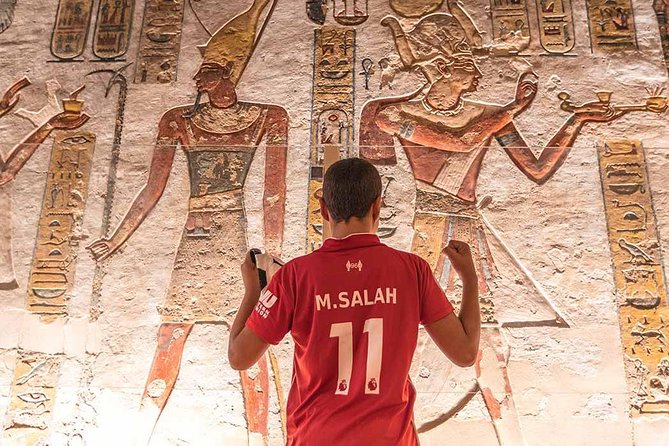
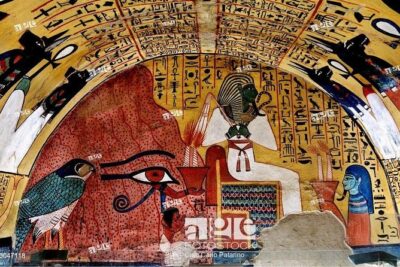
The Valley of the Kings can look surprisingly plain when you first arrive. It is a dry, red-rock gorge, not a grand city of ruins. The real attraction is underground, where 63 known tombs were cut into the valley during roughly five centuries of royal burials.
This is where a guide earns his or her fee. Without context, one decorated chamber can blur into another. With a good Egyptologist, the painted figures, funerary texts, royal symbols, and burial customs begin to make sense.
The valley was used from the 16th to the 11th century BC. Its most famous discovery came in 1922, when Howard Carter found the tomb of Tutankhamun and its celebrated treasures. Tutankhamun’s tomb is part of the valley experience, but the standard admission arrangement does not necessarily mean every special tomb or extra entry is included. Ask your guide what the included ticket covers before you arrive if seeing a particular tomb is important to you.
You have about two hours here, the longest single stop on the west bank. That is a sensible allocation. You need time for the approach, the tombs, photographs in permitted areas, and short pauses in the open heat.
Expect uneven ground, bright sun, and steps inside some tombs. The tour data says most people can participate, but anyone with limited mobility should consider the terrain and ask the operator for practical details before booking. Wear shoes with a firm sole, carry only what you need, and save your water for the walk between the vehicle and the tomb entrances.
Hatshepsut’s temple and the story of a female ruler
From the valley, the route continues to the Temple of Hatshepsut at Deir el-Bahari. This is one of Luxor’s most striking monuments from a distance because its broad terraces rise directly toward the limestone cliffs.
The design feels different from the enclosed temples you will see later. Long horizontal lines, ramps, terraces, and the cliff behind the temple create a strong sense of order. It is a place where the setting matters as much as the surviving stonework.
Hatshepsut ruled during the New Kingdom after the death of her father, Thutmose I, and her half-brother and husband, Thutmose II. Her position as a female pharaoh gives the guide a useful opening into questions of royal power, succession, image-making, and how rulers presented themselves to the public.
You have about an hour here. That is enough to understand the layout and hear the main story, but you may wish for longer if you are interested in reliefs or want to explore every terrace. The temple is exposed, so this is another point where an early start or cooler season would make the day more comfortable. The exact start time is not provided, so confirm it when you book.
A short stop at the Colossi of Memnon
The Colossi of Memnon take only about 15 minutes, and that is probably the right call on a day already packed with major sites. These two enormous seated statues once guarded the entrance to the mortuary temple of Amenhotep III.
Each statue is described as about 60 feet tall. Smaller figures representing the pharaoh’s wife and mother were carved near his feet, though scale makes them easy to miss from a quick roadside stop. Your guide can point them out before you move on.
The name Memnon comes from an ancient association with a mysterious sound once heard from the northern statue at sunrise. The sound was linked to damage caused by an earthquake and later repairs, giving the statues a famous story beyond their size.
This stop is primarily for photographs and a short explanation. Do not expect a long temple visit here. The mortuary temple itself is not presented as a full stop on this itinerary, so the value lies in seeing the statues up close and understanding their original role.
A completely different sort of day out in Luxor:
- Luxor: Shared Full-Day Tour to Luxor West and East Banks
★ 4.5 · 1,812 reviews - Luxor: Hot Air Balloon Ride over Luxor Relics
★ 4.8 · 1,681 reviews - Luxor Day Tour: Valley of Kings & Queens & Hatchepsut Temples
★ 5.0 · 1,496 reviews - Full Day Tour to East and West Banks of Luxor
★ 5.0 · 1,449 reviews
Karnak, where scale becomes the lesson
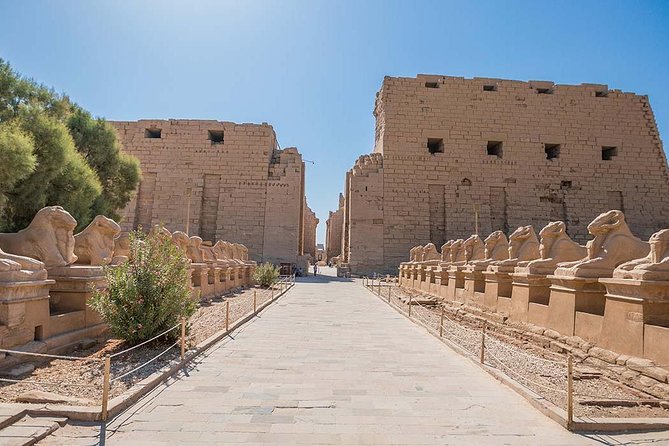
Karnak is the longest east-bank visit, with about two hours set aside. That time is welcome. This is not one compact building but a vast temple complex developed over about 1,500 years by successive pharaohs.
Karnak served as a major religious center, but its role was broader than worship. It also functioned as a treasury, administrative center, and royal complex during the New Kingdom. The size tells you something important about the wealth and organization behind ancient Thebes.
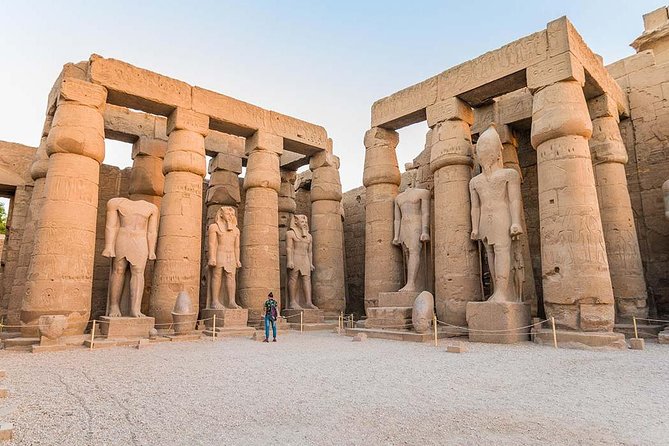
Your guide should help you read the site in sections rather than treating it as one giant pile of columns. Pylons mark ceremonial entrances. Sanctuaries reveal the religious heart of the complex. Columns, carved reliefs, and additions by different rulers show how each generation reshaped an older sacred center.
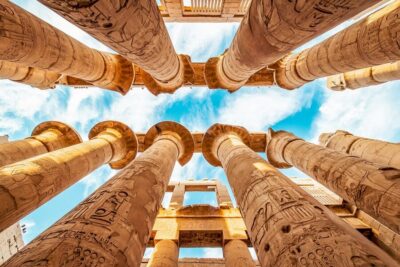
The Great Hypostyle Hall is likely to be one of your most memorable spaces. Its forest of columns makes human beings look very small, which is precisely the point. Give yourself time to look up, but also look at the carved surfaces near eye level. Details are easy to miss when you are concentrating only on scale.
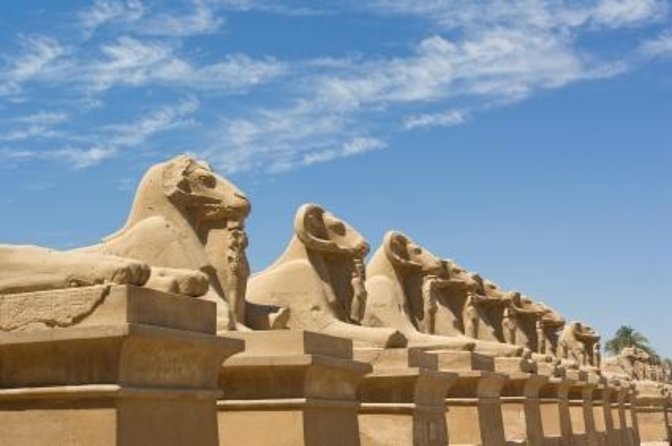
A route of small ram-headed sphinxes once linked Karnak and Luxor Temple. One account connected with this experience describes about 2,400 figures along the avenue, although the full route is not something you should expect to walk during this eight-hour tour. Use the guide’s explanation to understand the ceremonial connection between the two temples rather than assuming you will cover the whole avenue on foot.
Karnak can be overwhelming without a plan. The private format helps because you can ask your guide to pause, explain a particular scene, or move on when the main points are clear. Guides praised for reading hieroglyphs and selecting the most important facts can make this visit far more useful than simply wandering among columns.
Luxor Temple beside the modern city
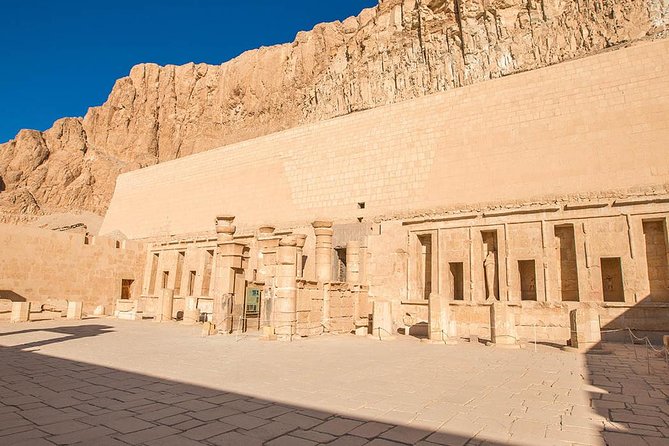
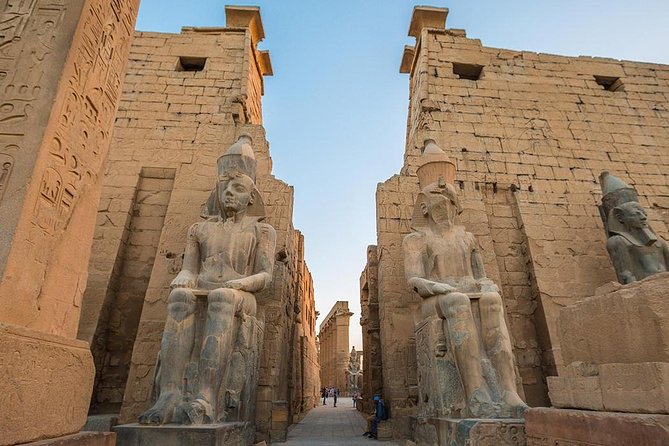
Luxor Temple gives the day a fitting finish. It sits in the modern city of Luxor, with the Nile nearby and contemporary streets close to the ancient walls. Few Egyptian monuments make the meeting of past and present so immediate.
The temple is well preserved compared with many ancient sites. Large sections of the structure, statues, and relief carvings remain, allowing you to see how the monument was organized and decorated rather than only imagining its original form.
Its setting also changes the mood. At Karnak, the huge complex can feel removed from ordinary life. At Luxor Temple, the modern city presses close, and the Nile is part of the view. You get a clearer sense that ancient Thebes was not an isolated ruin but a living capital.
One hour is assigned here. That gives you time to see the major elements and listen to the explanation, though the visit could easily stretch longer for anyone interested in architectural details. If your schedule brings you in the late afternoon, the temple may be lit after dark. That can create a memorable atmosphere, but arriving late may also mean less time at the earlier stops, so timing is worth confirming.
Lunch, water, and the practical rhythm of the day
Lunch at a good-quality restaurant is included. The exact restaurant and menu are not specified, so do not book this expecting a particular cuisine or dining setting. The real benefit is that you have a planned meal during a demanding day instead of losing time looking for somewhere suitable.
Bottled water is provided in the vehicle. That is a small inclusion, but it matters in Luxor, where heat and dust can wear you down before the monuments do. Bring additional personal water if you prefer to drink often, along with sun protection and clothing suitable for extended outdoor sightseeing.
The listed site times total a little over six hours. The remaining time allows for pickup, driving between the east and west banks, lunch, and the inevitable delays around major monuments. Do not treat the eight-hour estimate as a guarantee that you will be back at your hotel at a precise minute.
The private vehicle gives the day some flexibility, but it cannot change the basic distances or site opening conditions. You should expect a full schedule rather than a leisurely day beside the river.
The guide can make or break the experience
The strongest part of this tour is likely to be the person leading it. The most praised guides connected with the operator include Hany Refaat, Hany Taha, Hamy, Mansour, Marwa Ali, and El-Tayeb, also known as El T.
Specific strengths associated with these guides include explaining tombs and inscriptions without notes, reading hieroglyphs, answering questions patiently, finding efficient ways through the sites, and knowing when to stop talking so you can look around on your own. One guide, Hany Refaat, was especially praised for combining detailed explanations with time for photographs.
That balance matters. Egyptian monuments are full of names and dates, but a nonstop lecture can flatten the experience. A good guide gives you the key ideas, then lets you see the place for yourself.
You cannot choose a particular guide based on the information provided, so treat those names as useful examples of the standard you should hope for, not a promise of assignment. If a specific guide is important to you, ask Memphis Tours before confirming.
Who should book this tour?
I would choose this tour if you have only one day in Luxor and want the major sights handled in a logical order. It is also a good fit if you are arriving from a ship, dislike negotiating transport, or want a private guide rather than a large group with a fixed commentary.
It suits first-time visitors particularly well because it explains the difference between royal tombs, funerary temples, and state religious centers. Families and small parties may also value the private vehicle and the ability to adjust the guide’s pace.
I would think twice if you want long, unhurried visits, extensive photography time, or several lesser-known sites. The itinerary concentrates on the famous four stops, and the day is too short for every tomb, temple, and museum in Luxor.
Free cancellation is available up to 24 hours before the start time for a full refund. Changes made within 24 hours are not accepted, and poor weather can lead to a different date or a full refund. Tipping is not included, and any extras outside the stated plan cost more.
Is the $169 price fair?
For a private eight-hour tour, the price is reasonable if you value convenience and explanation. Admission fees can add up across four major sites, while a private vehicle, guide, lunch, water, taxes, and service charges are already covered.
The value is less compelling if you are traveling alone and are comfortable arranging transport and buying tickets yourself. The advantage here is not simply getting from place to place. It is having one person coordinate the route and interpret what you are seeing.
Group discounts are available, though the discount amount is not stated. If you are traveling with several people, compare the total group price before booking. The private format may become better value as the number of people in your party increases.
Should you book it?
Book this tour if you want a well-organized first look at Luxor, with both banks covered and the essential costs bundled into one price. The route is strong, the private setup is practical, and an excellent Egyptologist can turn a tiring day into a genuinely memorable one.
Skip it if your priority is slow exploration. For most people with limited time, though, the combination of Valley of the Kings, Hatshepsut, Karnak, and Luxor Temple makes this a sensible way to meet Luxor’s greatest ancient sites without wasting the day on transport planning.
FAQ
How long does the tour last?
The tour lasts approximately eight hours, including transportation, sightseeing, and lunch.
Is hotel pickup included?
Yes. Pickup and return are included from your hotel in Luxor. Pickup is also offered from your ship.
Is the tour private?
Yes. Only your group participates in the private tour or activity.
What type of vehicle is used?
Transfers are provided in a private, air-conditioned vehicle.
Is a guide included?
Yes. An English-speaking Egyptologist guide is included.
Are entrance fees included?
Yes. Entrance fees to the listed sites are included, including the Valley of the Kings, Hatshepsut’s temple, Karnak, and Luxor Temple.
Is lunch included?
Yes. Lunch at a good-quality restaurant is included.
Is bottled water provided?
Yes. Bottled water is available on board the vehicle during the tour.
Are tips included?
No. Tipping is not included. Extras not mentioned in the tour description are also excluded.
Can I cancel for a full refund?
Yes, if you cancel at least 24 hours before the experience start time. Cancellations made less than 24 hours in advance are not refunded, and poor weather may result in a different date or a full refund.
Just added around Luxor
- Private Tour foll day to East and West Banks of Luxor★ 5.0 · 23 reviews
- East and West Bank Luxor★ 5.0 · 23 reviews
- Full Day Tour to Luxor (East & West Bank)★ 5.0 · 23 reviews
- Big brother travel★ 5.0 · 23 reviews
- Luxor Day Tour :Valley of Kings & queen & Hatshepsut & Habu city★ 5.0 · 23 reviews
- Luxor: Scenic Camel or Horse Ride★ 3.9 · 24 reviews
- From Cairo: 4-Day Nile Cruise from Aswan to Luxor with Meals★ 4.4 · 24 reviews
- Traditional Egyptian Breakfast at the AlHabib Arabian Horse Farm★ 5.0 · 24 reviews
Luxor Tours, compared.
Luxor Valley of the Kings & Tutankhamun Tomb Trip
Read our review →
Luxor Day Trip from Hurghada Small Group & Tutankhamun Tomb
Read our review →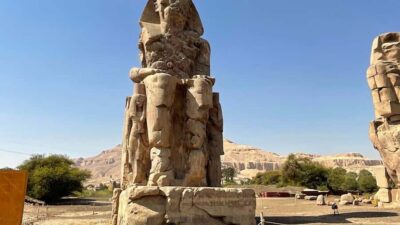
Shared Full-Day Tour to Luxor West and East Banks
Read our review →
Luxor Day Tour: Valley of Kings & Queens & Hatchepsut Temples
Read our review →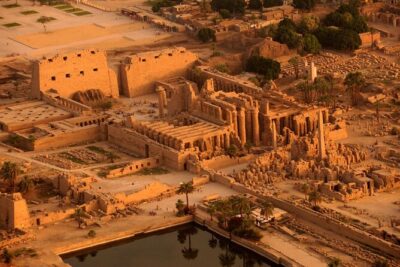
Full Day Tour to East and West Banks of Luxor
Read our review →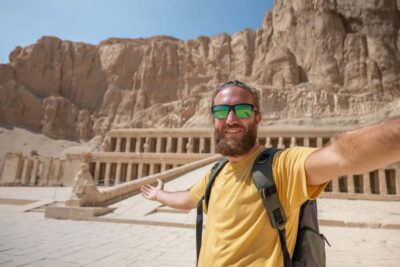
Valley of the Kings and Hatshepsut Temple Day Tour
Read our review →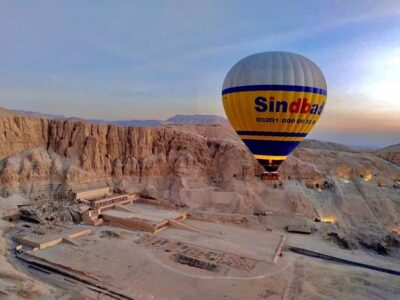
2-Day Luxor Tour with Hotel, Balloon, & Boat Ride
Read our review →Browse the lists this tour appears in