
Reviewed · ABU SIMBEL TOURS
2 days 1 night Luxor,Aswan & Abu simbel by flight from Cairo
Egypt packs its greatest monuments into two very long days. This $500 trip links Abu Simbel, Aswan, and Luxor by air and private car, saving you the long overland journey from Cairo. I like the private vehicle, included flights, and personal guides. The catch is a punishing schedule, with early starts, long drives, and little room for delays.
I also like how much is covered: airport transfers, entrance fees, lunch, bottled water, and one night at an Aswan hotel. Guides such as Ahmed, Samir, Maria, DoA, Hamees, and Ghada have earned warm praise for clear explanations and kind help. Still, communication about pickup times and flights can be uneven, so you should confirm every transfer before departure.
In This Review
- Key points to know before booking
- What this two-day route really offers
- The 4 a.m. Cairo pickup and flight to Aswan
- Abu Simbel: the long road to Ramses II
- Aswan’s dam, obelisk, and island temple
- One night at Basama Aswan Hotel
- The Aswan to Luxor road transfer
- Valley of the Kings and Hatshepsut’s temple
- Colossi of Memnon: a quick stop with a big view
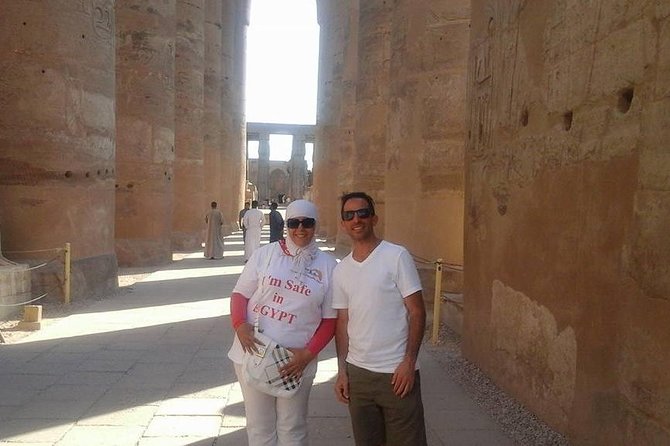
- Karnak Temple and its giant columns
- Luxor Temple before the flight home
- Guides, drivers, and the private format
- Is $500 a fair price?
- Who should book this Egypt tour?
- My verdict: efficient, exciting, and demanding
- FAQ
- How long is the tour?
- Where does the tour begin?
- What time is pickup from Cairo?
- Are flights included?
- Is Abu Simbel included?
- How do you travel from Aswan to Abu Simbel?
- Where is the overnight accommodation?
- Is transportation private?
- Is lunch included?
- What is the cancellation policy?
Key points to know before booking
- Abu Simbel requires a three-hour drive from Aswan, but the reward is Egypt’s most dramatic temple setting.
- The tour begins around 4 a.m. from Cairo or Giza, and the second day is also an early, full sightseeing day.
- Private air-conditioned transport gives you a quiet place to rest between sites.
- Luxor gets the fullest sightseeing day, covering the Valley of the Kings, Hatshepsut, Colossi of Memnon, Karnak, and Luxor Temple.
- Domestic flights and admissions are included, making the $500 price easier to justify.
- Pickup details may change, and flight delays have affected some departures, so stay in touch with the operator.
What this two-day route really offers
This is a time-saving introduction to Upper Egypt, not a relaxed holiday. You see the major monuments from Aswan and Luxor, but you spend plenty of time in airports and on roads.
From Cairo, the trip uses a domestic flight to Aswan, followed by private driving. The route then returns north by car to Luxor, where you tour the west and east banks before flying back to Cairo. It is an efficient arrangement, but efficiency comes with a price: very little sleep and almost no spare time.
I would choose this plan if you have only a short stay in Egypt and want temples rather than a Nile cruise. If you have four or five extra days, slowing down in Luxor and Aswan would give you a better feel for both places.
More Evening Trips in Cairo
- Cairo: Nile Sunset Dinner Cruise, Show & Optional Transfer
★ 4.1 · 2,184 reviews - White & Black Desert tour 2 Days 1 night camping from Cairo.
★ 5.0 · 649 reviews - White & Black desert camping tour 2 Days 1 night From Cairo
★ 5.0 · 467 reviews
The 4 a.m. Cairo pickup and flight to Aswan
Your day begins with hotel pickup in Cairo or Giza at about 4 a.m. A representative should meet you in the hotel lobby with a sign showing your name, then take you to Cairo Airport in a private air-conditioned vehicle.
That private transfer is useful at such an early hour. You do not need to find a taxi or navigate the airport alone, and the driver takes care of the first part of the journey. The weak point is timing. Some departures have suffered flight delays, while others received changing pickup times or flight arrangements without much advance notice.
I would ask for these details in writing before the trip:
- Your exact Cairo pickup time
- Your Cairo to Aswan flight number
- The name and phone number of your Aswan guide
- The expected return time to Cairo
- The name of the Aswan hotel
The flight saves many hours compared with traveling by road from Cairo. It also lets you begin the experience in southern Egypt, where the monuments are spread along the Nile and into the desert.
Abu Simbel: the long road to Ramses II
After landing in Aswan, you meet another guide and driver, then travel about three hours by private car to Abu Simbel. That is a long ride after an early flight, but the destination earns its place on the route.
The Abu Simbel complex contains two temples cut into the rock. The larger temple honors Ramses II and presents four huge seated figures at the entrance. Inside, the scale, carved walls, and religious imagery make this one of the most powerful ancient sites in Egypt.
The smaller temple honors Queen Nefertari and is linked with Hathor. Its presence beside Ramses II’s temple is important: the pair gives the queen unusual prominence and shows how royal power and religious symbolism worked together.
The temples were moved to higher ground in a major preservation effort after the Aswan High Dam threatened to flood the original site. That fact adds another layer to the visit. You are not only looking at ancient monuments, but also at a modern effort to save them.
The description of the tour highlights the sunlight that reaches the inner sanctuary twice each year, on October 22 and February 22. Those dates are especially meaningful for visitors interested in the temple’s design, though this two-day trip does not appear to be built around a special solar event.
You should expect around three hours at the Abu Simbel complex, with admission included. Wear practical shoes, carry water, and protect yourself from the sun. The drive, heat, and early start can make this the day’s most tiring stop, even though it is also one of the most memorable.
Aswan’s dam, obelisk, and island temple
After Abu Simbel, the route returns to Aswan for several major sights. The order can change, especially when flight times or road conditions shift, so do not worry if the day does not follow the printed sequence exactly.
The High Dam gives you a clear look at the modern project that reshaped the Nile and created Lake Nasser. Its visit is brief, but it helps explain why Abu Simbel had to be relocated.
The Unfinished Obelisk offers a different kind of lesson. Here, the stone remains attached to the quarry bed, showing how ancient workers began shaping enormous granite monuments. You can see the practical side of Egyptian building, not just the finished temples.
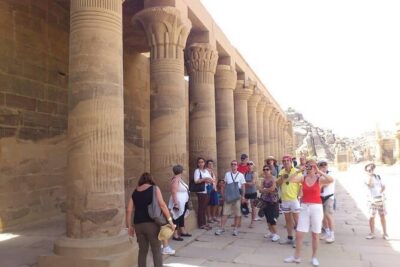
Philae Temple is usually the artistic highlight of Aswan. The sanctuary sits on an island and is reached by boat, though the supplied details do not specifically confirm whether the boat ride is included. Ask before departure. The temple complex has a graceful setting and a layered past, with construction and additions from several periods.
One confusing point in the schedule is that the first day heading mentions Philae before describing Abu Simbel, then lists Abu Simbel again as a separate stop. Treat the schedule as a route outline rather than a minute-by-minute promise. Confirm the actual order with your guide on arrival.
More ways to reach Abu Simbel:
- Our Exceptional 5 days Cairo, Luxor and Abu Simbel Tour Package
★ 5.0 · 212 reviews - From Cairo: 2-Day Abu Simbel & Luxor Tour
★ 3.9 · 136 reviews - 3 Night Luxor and Aswan Nile Cruise with Hot Air Balloon, Abu Simbel from Luxor
★ 5.0 · 76 reviews - Egypt 8 Day :Cairo, Aswan , Nile Cruise , Luxor, Abu Simbel,Hotel
★ 5.0 · 42 reviews
One night at Basama Aswan Hotel
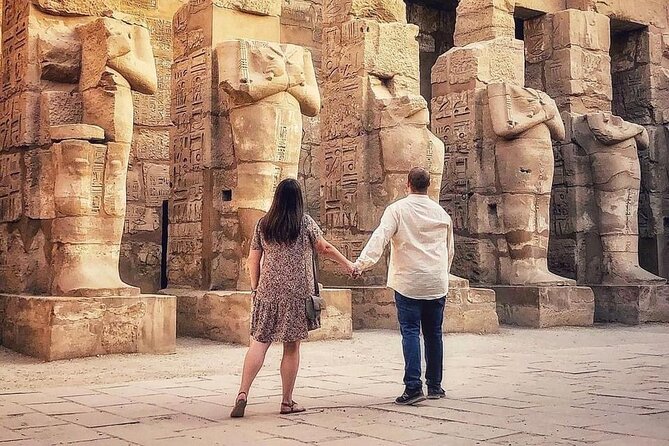
The advertised accommodation is Basama Aswan Hotel, described as a four-star property. Some arrangements have used a different hotel, including a property called Paradise, so the exact accommodation may depend on availability.
That matters because this is not a leisurely hotel stay. You arrive after Abu Simbel and Aswan sightseeing, then leave the next morning for Luxor. The room is mainly a place to sleep, shower, and recover.
The overnight stop does have practical value. Without it, Abu Simbel and Luxor would be an even harsher pair of days. You also avoid returning to Cairo between the two southern destinations.
Lunch is included, but dinner is not listed among the inclusions. Ask your guide about the evening meal and any extra restaurant costs. Tipping is also excluded, as is the Egyptian visa.
The Aswan to Luxor road transfer
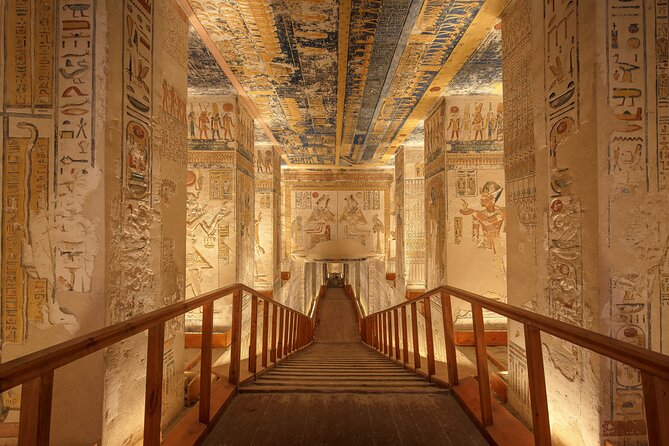
The second day begins with a private road transfer from Aswan to Luxor. The vehicle is air-conditioned, and having a driver for your group gives you more comfort than joining a large coach.
Still, this is not a short hop. You should expect a substantial portion of the morning to be spent on the road before reaching Luxor’s west bank. The advantage is control: you can rest in the car between sites, and the driver handles the route.
The vehicle and drivers receive some of the strongest praise in the available feedback. Drivers including Hosam were described as safe, accommodating, and dependable. That is important here, since you will be tired and carrying luggage or day bags after the hotel departure.
Valley of the Kings and Hatshepsut’s temple
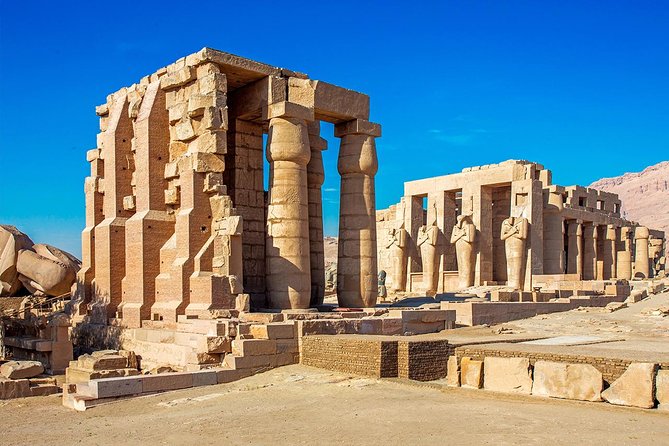
The west bank begins with the Valley of the Kings, where royal tombs from several dynasties were cut into the hills. The standard admission covers entry, but the number of tombs open at a given time can vary. If you have a particular tomb in mind, ask your guide what is available that day.
This is a place where a guide can make a real difference. The painted scenes and burial customs can look confusing without context, and a good explanation helps you notice the small details rather than simply walking through decorated chambers.
Next comes the Temple of Hatshepsut at Deir el Bahari. Its broad terraces rise against the cliffs, giving it a shape unlike the more enclosed temples at Karnak or Luxor. Hatshepsut ruled Egypt for about 20 years during the 18th Dynasty, and her temple reflects both religious purpose and royal ambition.
The planned visit to the west bank lasts about two hours, with Hatshepsut’s temple listed separately for another two hours. In practice, the schedule may feel compressed because it also includes the drive from Aswan and the other Luxor stops.
Colossi of Memnon: a quick stop with a big view
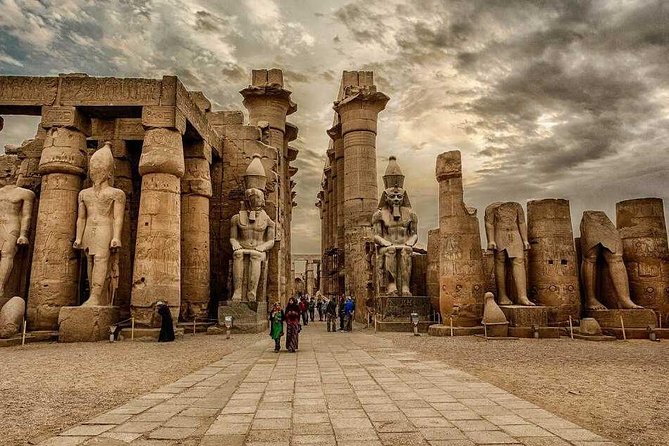
The Colossi of Memnon are two enormous seated statues associated with the mortuary temple of Amenhotep III. The stop is only about 30 minutes, so think of it as a photo and orientation stop rather than a full archaeological visit.
The statues face toward the Nile and once formed part of a much larger complex. Your guide can help place them in the setting of the ancient west bank, where royal burial and memorial buildings spread across the plain.
This is a good example of the tour’s style: you see the essential sight, hear the main explanation, and move on. If you prefer to linger at each monument, the schedule may frustrate you.
Karnak Temple and its giant columns
Karnak is the largest and most demanding sight on the east bank. The complex grew under many rulers, so it feels less like one building and more like a long record of Egyptian religious and royal history.
The route includes the Avenue of Sphinxes, the Hypostyle Hall, obelisks linked with Hatshepsut and Thutmose III, the temple of Amun, the sacred lake, and a large scarab connected with Amenhotep III. The Hypostyle Hall, with its 134 columns, is the visual centerpiece.
The listed visit is about one hour, which is tight. I would stay close to your guide at the start, listen for the main points, and then use any free minutes for photographs. The site can feel overwhelming if you try to understand every wall and courtyard at once.
Some guides, including Hamees and Ghada, have been praised for giving an overview before letting people explore and take photographs. That approach works well here, since it keeps the visit focused without turning it into a nonstop lecture.
Luxor Temple before the flight home
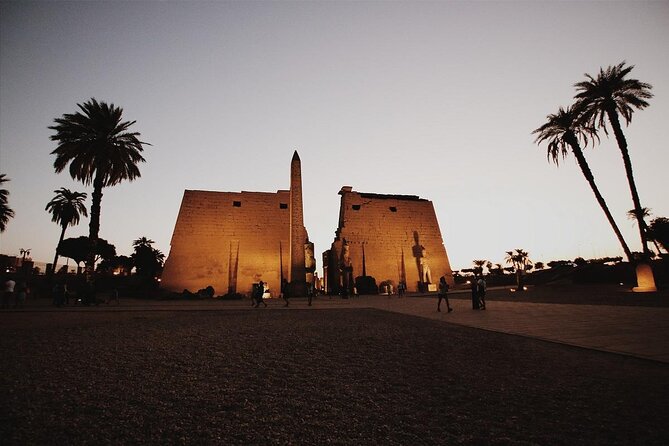
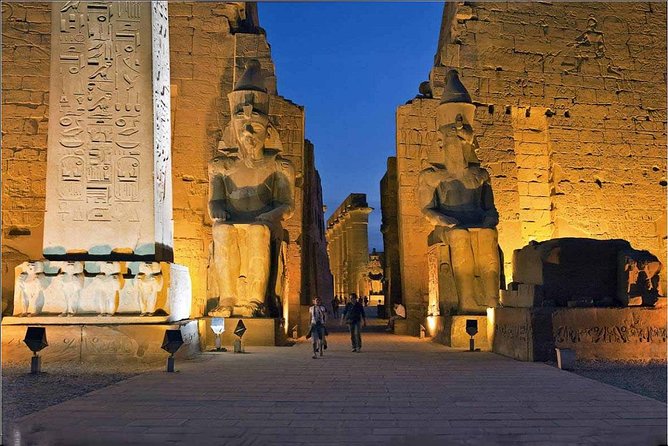
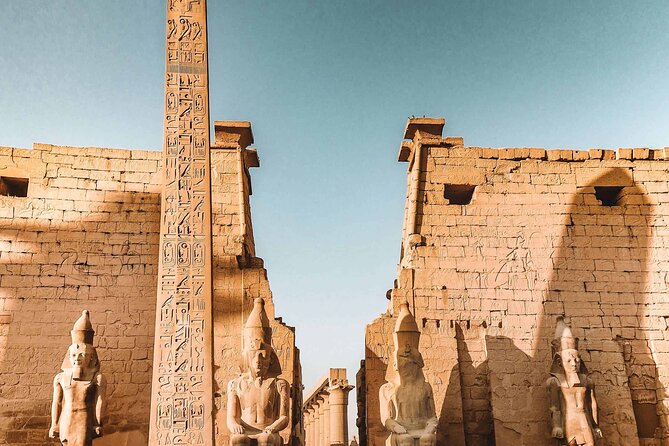
Luxor Temple is a fitting final stop. Built under Amenhotep III and completed by Ramses II, it sits in the modern city and has a more compact layout than Karnak.
You can expect to see the courtyard, columns, statues, and monumental entrance features. The temple’s position within present-day Luxor gives it a different feel from the isolated desert sites. Ancient stone and modern streets sit close together.
The schedule allows about two hours here before the transfer to Luxor Airport. That gives you more breathing room than the brief stop at the Colossi, but flight timing remains important. A delay earlier in the trip can reduce time at the final sites.
After landing in Cairo, a representative is meant to meet you and transfer you back to your hotel. Confirm this final pickup, since one account described a wait of around 20 minutes before the Cairo airport driver arrived.
Guides, drivers, and the private format
This is a private tour, so only your own group participates. That is a major advantage when you are trying to cover this much ground. You do not have to wait for a large bus or follow another group’s pace.
Guide quality can vary by day and language. Names praised for strong explanations include Ahmed, Samir, Maria, Mustafa, Mohamed, Aida George, DoA, Daria, Hamees, Ghada, Shereen, and Mohamad. One account specifically praised Ahmed on the first day but found the second guide less effective, including a complaint that the guide did not enter the monuments with the group.
That makes an important practical point: ask whether your guide will accompany you inside each site and what language will be used. A private car does not automatically mean the same guide will stay with you for both days.
Communication also deserves attention. Some arrangements have been smooth, with WhatsApp support and frequent updates. Others involved unclear pickup times, changing plans, or poor replies. Keep your phone available and request a complete schedule before you leave Cairo.
Is $500 a fair price?
At $500 per person, the price is not cheap, but it covers the costly parts of this route: two domestic flights, airport transfers, private air-conditioned transport, guides, entrance fees, bottled water, lunch, and one hotel night.
The private format adds value. You are paying not only for admission tickets, but also for a driver, airport help, and a route that would be difficult to organize in two days on your own. For someone with limited time, this can cost less than arranging separate flights, cars, guides, and hotel bookings.
It is also described as a lower-cost alternative to a Nile cruise while covering many of the same headline sights. You do not get the slow river views or relaxed pace of a cruise, but you do get a concentrated look at Abu Simbel, Aswan, and Luxor.
The price feels fair if every transfer works and the guide is strong. It feels less attractive if flights are badly timed, communication is weak, or hotel arrangements change without clear notice.
Who should book this Egypt tour?
I would recommend it to you if you have only two days for southern Egypt, want private transport, and care more about major monuments than quiet mornings. It suits energetic visitors who can handle a 4 a.m. start, a three-hour Abu Simbel drive, and a full day in Luxor.
It is less suitable if you want a slow cultural trip, dislike frequent hotel and airport changes, or need a predictable schedule. Families with young children and anyone who struggles with long days should think carefully before booking.
You should also compare the total price with a longer independent stay in Luxor and Aswan. That option may offer more rest, but it will require arranging transport and flights yourself.
My verdict: efficient, exciting, and demanding
This tour gives you the best argument for organized travel in Egypt: it connects sites that are difficult to cover quickly, and the private car makes the long transfers easier. Abu Simbel and Luxor are the clear stars, while Philae, the High Dam, and the Unfinished Obelisk round out the Aswan day.
The weak spots are real. Flight times may not be ideal, pickup details can shift, hotel names may change, and guide quality is not perfectly consistent. Get every important detail confirmed, keep your expectations realistic, and arrive rested if possible.
Book it if time is your main concern. Skip it if you can give Upper Egypt several relaxed days. For a short Egyptian holiday, though, this is a powerful, good-value route that puts an astonishing amount of ancient history within reach.
FAQ
How long is the tour?
The experience lasts approximately two days and includes one overnight stay.
Where does the tour begin?
Pickup is offered from hotels in Cairo or Giza City.
What time is pickup from Cairo?
The first pickup is scheduled for about 4 a.m.
Are flights included?
Yes. The package includes flight tickets, with a flight from Cairo to Aswan and a domestic flight from Luxor back to Cairo.
Is Abu Simbel included?
Yes. Admission to the Abu Simbel Temple Complex is included.
How do you travel from Aswan to Abu Simbel?
You travel by private air-conditioned vehicle, and the drive takes about three hours each way.
Where is the overnight accommodation?
The accommodation is listed as Basama Aswan Hotel, described as a four-star hotel. Hotel arrangements may vary, so confirm the property before departure.
Is transportation private?
Yes. The tour includes a private tour, private air-conditioned transfers, and a personal driver.
Is lunch included?
Yes. Lunch is included in the package. Tipping, dinner, and the Egyptian visa are not included.
What is the cancellation policy?
You can receive a full refund if you cancel at least six full days before the start time. Cancellation two to six full days ahead may receive a 50 percent refund, while cancellations less than two full days before departure are not refunded.
More 2-Day Experiences in Cairo
- Cairo: 2-Day Bahariya Oasis Camp and Desert Tour
★ 4.9 · 616 reviews - 2 days cairo and giza attractions plus Gem, private tour
★ 5.0 · 231 reviews - All Inclusive 2-Day Private Tour to All Pyramids and Cairo and 2 evenings
★ 5.0 · 187 reviews - Cairo: 2-Day Bahariya & White Desert Private Camp Adventure
★ 4.8 · 147 reviews
Just added around Cairo
- Day Tour To Giza Pyramids, Great Sphinx, Saqqara Pyramids & Memphis Capital★ 5.0 · 23 reviews
- GEM Grand Egyptian Museum Private Tour from Cairo Giza hotels★ 5.0 · 23 reviews
- Cairo vip two or one day pyramids ,Museum,memfis ,saqra and7 places★ 5.0 · 23 reviews
- Giza Pyramids, Sphinx, Saqqara, and Dahshur Tour with Camel Ride★ 5.0 · 23 reviews
- Full-Day Tour to Giza Pyramids Saqqara Memphis Sphinx Private★ 5.0 · 23 reviews
- 8 Day Cairo Pyramids and Nile cruise and Alexandria All inclusive Private Tour★ 5.0 · 23 reviews
- Full-Day Tour to Giza Pyramids, memphis and Sakkara Step Pyramid★ 5.0 · 23 reviews
- Half Day Guided Trip To Egyptian Museum★ 4.5 · 23 reviews
Abu Simbel Tours, compared.

4-Days Nile Cruise From Aswan To Luxor including Abu Simbel and Hot Air Balloon
Read our review →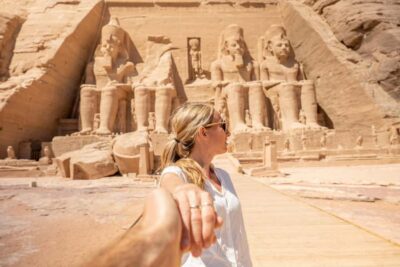
4-Day 3-Night Nile Cruise from Aswan to Luxor including Abu Simbel, Air Balloon
Read our review →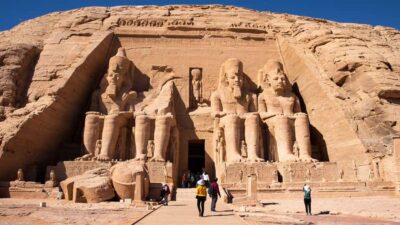
Abu Simbel Temple Private Guided Day Trip with Lunch
Read our review →4-Days Nile Cruise From Aswan To Luxor including Abu Simbel and Hot Air Balloon
Read our review →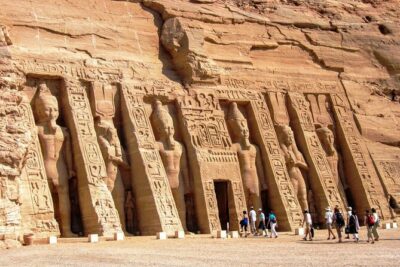
Private Day Tour to Abu Simbel Temples from Aswan
Read our review →4 Days Nile Cruise from Aswan to Luxor including Abu Simbel and Hot Air Balloon
Read our review →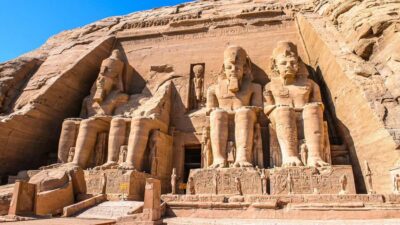
Browse the lists this tour appears in